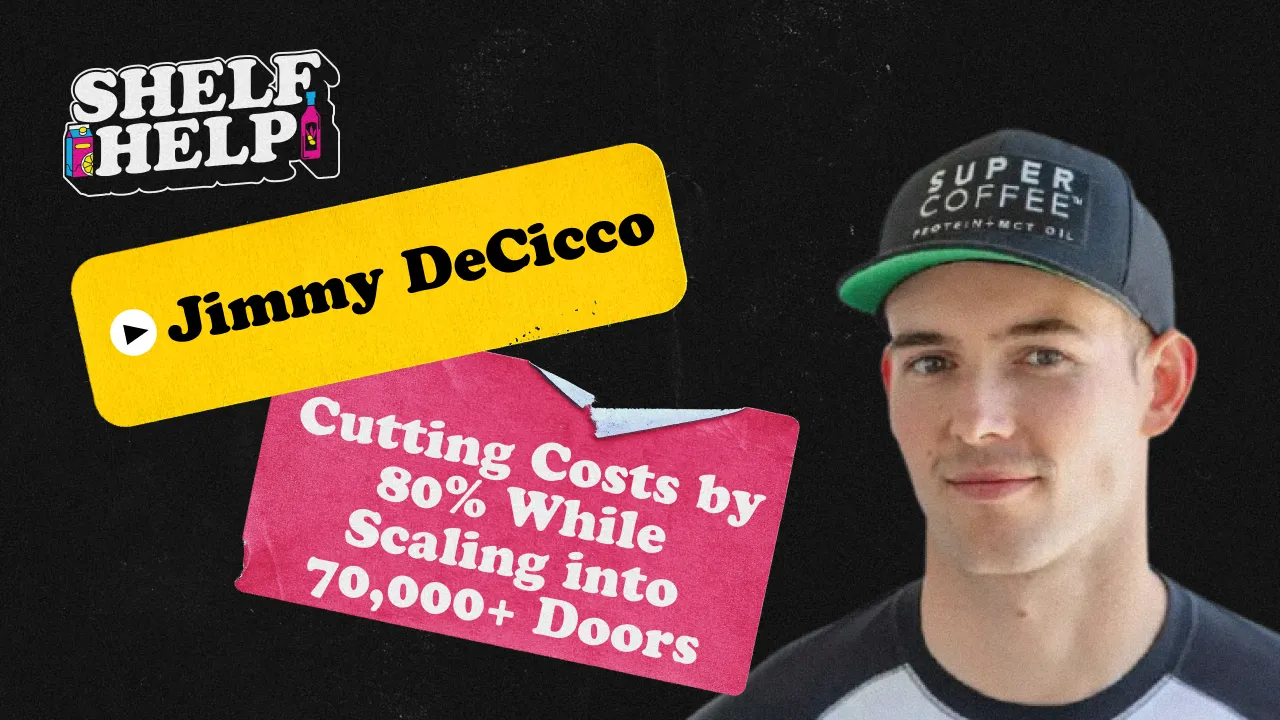
Cutting Costs by 80% While Scaling into 70,000+ Doors | Jimmy DeCicco, Super Coffee



On this episode, we’re joined by Jimmy DeCicco, Co-founder and Executive Chairman of Super Coffee, the RTD coffee brand started by Jimmy and his two brothers that went from a dorm-room blend to 70,000+ doors and a $50M+ run rate.
A former captain of the Colgate football team, Jimmy unpacks what they got wrong when they tried to go “big-league” too soon, and the profit-first reboot that followed. We dive into how the team executed a 65→15 SKU rationalization and an 80% cost reset, plus Super Coffee’s “neighborhood by neighborhood” approach.
We also cover exec team shake-ups, how a seasoned CMO sharpened positioning, and the systems that actually drive velocity.
—---------------
Episode Highlights:
🏈 From Colgate captain to CPG operator
🧪 Early R&D: cracking protein + coffee + zero added sugar,
🏭 Co-packers
🧃 Brand evolution: early cues from Honest Tea
🎯 Identity-building
🚚 Distributor partnerships: what “true partnership” looks like
🗺️ “Neighborhood by neighborhood” approach
🏟️ Thinking they were “big-league ready” everywhere at a $25M run rate
📊 The 80/20 reality: doubling down on hero SKUs and hero doors
🛒 Big-box takeaways: Target, Walmart, Albertsons
⛽ C-store strategy
✂️ SKU rationalization
💸 Cutting costs by 80%
🧭 Bringing in a seasoned CEO,
🔭 Trends Jimmy is tracking
—---------------
Table of Contents:
00:40:23 - Intro and origin story
02:14:01 - Captain of the Colgate football team to captain of Super Coffee
05:39:24 - The early days of R&D and formulation
08:19:15 - Copackers and scaling up
11:51:13 - The evolution of the brand (initial influence from Honest Tea)
13:53:12 - Recommendations for building a brand identity
16:03:13 - An invaluable contribution from Super Coffee’s seasoned CMO
16:49:24 - Building a true partnership with your distributor
19:10:24 - A “neighborhood by neighborhood” approach
21:33:23 - Thinking they were ready for the “big leagues”
22:52:08 - The 80/20 rule is real
23:46:19 - Target, Walmart, Albertsons, etc.
25:53:21 - C-stores
29:04:10 - SKU rationalization (65 SKUs to 15 SKUs)
32:37:21 - Cutting costs by 80%
35:17:01 - Bringing in a seasoned CEO, and back again
37:52:23 - Trends Jimmy is tracking
—---------------
Links:
Super Coffee – https://www.drinksupercoffee.com
Follow Jimmy on LinkedIn – https://www.linkedin.com/in/jimmy-decicco/
Follow me on LinkedIn – https://www.linkedin.com/in/adam-martin-steinberg/
For help with CPG production design - packaging and label design, product renders, POS assets, retail media assets, quick-turn sales and marketing assets and all the other work that bogs down creative teams - check out KitPrint.
Episode Transcript
Speaker 1: 00:00
Welcome to Shelf Help. Today we're speaking with Jimmy DeSico, co-founder, executive chairman of Super Coffee, joining us from Austin. For those of you that don't know, Super Coffee is an RTD coffee brand launched by Jimmy and his two brothers right out of undergrad. That's has since grown into a multi-hundred million dollar brand. So really excited to get into it. So yeah, Jimmy, just for the listeners, probably a fairly small group in the CPG world that aren't that familiar with super coffee, maybe just give us a quick lay of the land in terms of origin story, why behind the brand, core products you guys offer. And I know you guys are found in so many places, but maybe just one or two places people can get their hands on them, and then we'll go from there.
Speaker: 00:41
Yeah, man. Great to be here, Adam. I appreciate you, brother. Super coffee, it's a bottled coffee with zero sugar and 10 grams of protein in our core lineup. And I started it with my two younger brothers 10 years ago. We celebrated our 10th birthday in June of 2025. And we were tired athletes. You know, we all played sports in college and we didn't want to drink a Starbucks rapppuccino that had 46 grams of sugar and 300 calories. So started brewing coffee for ourselves. It was actually my youngest brother's idea. And he started brewing coffee for himself and his teammates and his classmates. And he called us up, me and Jake, and said, guys, I'm dropping out of school to start a coffee company. And we're like, what the hell are you talking about, man? Like, this is this is crazy. Stay, stay in school. You know, he was a full scholarship basketball player. And uh that was that's how we got started. And we didn't know much about bottled coffee or beverages, but we just knew that if you were selling something for three dollars a bottle, you needed to sell a lot of bottles to make money. So we were really focused on sales in the early years, and I think that led to a good foundation of like sales execution and distribution execution and like building a brand intentionally in a region before expanding nationally and a bit broader.
Speaker 1: 01:50
Yeah. Yeah, really getting good at that ground game is seems to be a really important step that really moves the needle. Sounds like it's definitely a family of uh athletes. I know you're the quarterback captain of the team at Colgay, which I can resonate with. I played in a D3 conference up in the Pacific Northwest. Uh definitely another game. I mean, I think uh, you know, D1, even Ivy League is a little different than Division III, but I can resonate to a certain extent. How do you feel like leading leading a football team, especially as a quarterback, which is I feel like there's so many parallels there between run of the company too? Like, how do you feel like that set you up for success as you as you built and led the super coffee team?
Speaker: 02:28
Yeah, man. Um, I think sports was a huge part of our identity growing up. And I was a quarterback in high school, and I got recruited to play quarterback at Colgate. And when I got there, they were like, hey man, you you run the ball better than you throw it. We're gonna we're gonna stick you in the backfield. So I ended up playing just about every position on offense, uh, a couple games of quarterback, but mostly running back and wide receiver. But yeah, captain of the team my senior year, which was a huge honor. And I think being an athlete, especially in a team sport, you realize that you all need to be moving in the right direction to achieve a common goal. You know, in a game like football, there is no one player who's going to change the game. You know, all 11 guys on the field need to do their job. And I think that is a crucial lesson in business as well. Nobody's going to be a hero, you know. People to do their jobs and do their responsibilities and make sure you're aligned on what that goal is and have the humility to lead from the front lines, I think is super important. You know, like I was always the first guy to practice. I was always the when my dad dropped me off at my first pop warner practice when I was eight years old, he said, be the first guy to the water cooler. And I was like, What do you mean? Like I it in the whole idea of just like hustling on and off the field, uh, and that really set a mentality for us, me and my brothers from a young age. And when that translated into business, it's like we were never afraid to stock the shelves and pour the samples and show up at the factory early, you know, and and I think our team, as we grew, our team really respected that that we were out there with them. You know, I got dinner with my brother Jake last night. The company's 10 years old. He got on a flight at 5 a.m. on Sunday, flew to Arizona, he visited six Sam's clubs and did two demos that day at the Sam's clubs and was home for dinner back in Austin that night. Crazy. And it's like you really just do it for a decade, you know, it's just part of who you are. There's no ego, there's no no job that's that's beneath us. And I think we owe that to sports.
Speaker 1: 04:19
Yeah. Just with the confidence you gained and that experience of leading a team and at a pretty high level. I know it was your your brother's idea that kind of where it was born out of, but do you do you think you and and your brothers also, because they all sound like they're all athletes, you guys, feel like you would have been less likely to have launched a company straight out of school and said, hey, we're gonna do this if you guys hadn't had that confidence of had a lot of success and leading teams in the sports world?
Speaker: 04:44
Yeah, probably less likely. You know, I I think sports was all we knew, so we leaned into it. And as a result, our our grades probably suffered. You know, we weren't we didn't really have a lot of technical skills or interests outside of of sports, you know. So I I think we were fine students, but we weren't we weren't like the head of the class and anything, you know, we didn't really have any any gifts in the classroom. So I think sports taught us how to work hard and and how like really that grit that's required to hang in there longer than others. You know, there's a lot like we've been doing this for 10 years, and and it's clear to me that this takes it, it truly takes a decade, you know, and and I think people get discouraged after six months or after 12 months of hustling and working hard, they get burned out, you know, and and I think sports allows you to like get comfortable with that sort of pain and discomfort. Uh so yeah, it it was a really great precursor or like prerequisite for for getting in the business.
Speaker 1: 05:37
Yeah, totally. I can resonate with that. Well, yeah, let's rewind back to those early days when you're in that initial RD formulation stage. I think that true original formulations you mentioned, I think, is what I read came out of your brother's dorm room. He was blending coffee, protein, MCT oil together. I think. I'm curious once you guys decided you're gonna actually build a brand, what do those like next few steps look like in terms of from the formulation standpoint, iterating the formulation to the point where you felt like you had the first version that you felt good about bringing to market? And what were those kind of key variables you guys played around with?
Speaker: 06:11
Yeah, um, this was tricky because the first version we brought to market wasn't very good. You know, it didn't taste good, it was clumpy, you know, the protein separated from the coffee. You have like a very acidic coffee and a very basic protein. So like we couldn't get that natural product to sort of hold as a consistent solution. That was tricky. And I think what we did a good job of is like not waiting until it was perfect. You know, like we went and we sold what we made and it wasn't great. The packaging was kind of wrinkly, like it it was just if you looked at it today, you'd be like, it didn't belong in the store, you know. And and I think launching something before you're ready or launching something that's imperfect is uh a great lesson here. Look, it it pays to be thoughtful and it pays to like do the work first. But for us, like you're never gonna be ready, you know, it's never gonna be perfect. And and I think Mike Tyson's quote was super relevant here where everybody has a plan until they get punched in the face, you know, and like you put your product on the shelf and you think you have this idea of your head in your head of like how it's going to do and how how great it is. And then you get feedback from customers and all of that changes. So the the thing about bringing a food and beverage product to market is you can always iterate, you know, you can always improve. And from factory to factory, like as you switch from a culinary kitchen to a contract manufacturer to a bigger facility, there may be different processing requirements. There may be different cooking temperatures, you know, there may be different pasteurization methods that all require different ingredients, different food science, different sweeteners. For us, it always we always stayed true to our core, which was zero sugar, low protein, or sorry, zero sugar, adequate protein. So like 10 grams, we just launched a 25 gram version of protein and healthy fats. We add MCT oil. And then things have changed along the way, emulsifiers, our sweetener system has changed several times, but it's always been sugar-free. You know, so I I think another thing that happens in 10 years is the flavor technology, the flavor technology gets a lot better. And you know that the packaging gets a lot better. You know, those shrink, those shrink wraps look a lot more high def today than they did 10 years ago. So you can always improve and always iterate on the core thing.
Speaker 1: 08:18
Yeah. Yeah, you touched on it a bit. I know you spent those like first year or two on a small bottom line. I think it was in like the back of a domino sugar factory I read, if that was correct. And then yeah, shifted to a smaller copacker in Maryland and then eventually to bigger facilities. What were some of the most challenging parts of that transition of going from that little kitchen in the back of Domino all the way up from, you know, Maryland to that bigger co-packer?
Speaker: 08:41
Yeah, I think the big changes for us in Maryland, we were an HPP product, which is high pressure processing. And basically it was what cold pressed juices go through. You know, it's like you have a refrigerated shelf life, it's 60 to 90 days, product expires super quickly. And that was the first, that was the smallest place that would take us. And all of these big contract manufacturing facilities have minimum run sizes that are that that could bankrupt a small company. You know, like we weren't in a position to put $50,000 or $100,000 into a production run when we didn't even have a store to sell us yet. You know, so we we took what we could get, and it was this guy who had a line in the back of a domino sugar factory. We showed up, we made the product, we got into one store and we poured samples until we were the best seller in that store. And then we took that data to the store down the street, did the same exact thing. You know, we poured samples until we became the best-selling bottle of coffee in the entire neighborhood, you know, and before long it was 20 stores, then 50 stores, then 100 stores. And once you're selling to 100 stores, you then have the volume and the velocity to move up to a new, a new facility. And thankfully, we graduated from a 90-day shelf life to an 18-month shelf life. And that was a process learning what changes needed to be made, how to how to balance the pH in the product for it to be shelf stable and withstand the heat. You know, protein was getting cooked and denatured at certain temperatures. So I think that is it it was a great lesson. And and thankfully, we we navigated our way to several different copackers and and each time was an upgrade, and you sort of rely on their food safety and their their labs to really make a product, like a sort of food like that they're truly chemists, you know, that are making our recipe shelf stable at scale.
Speaker 1: 10:27
How did you guys go about finding your copacker and her copackers as you guys evolved from one to the next and from a evaluation and due diligence process? How did you really know who the right one was?
Speaker: 10:38
Yeah. So, like I said, in the early days, you sort of take what you can get. You know, you work with whoever's willing to give you an opportunity and you make do. And for us, that meant being refrigerated and perishable within 90 days, you know. Uh, and then from there you scale. And as you get traction and as you start to really prove that you have product market fit, advisors start to reach out, you know, people start to recognize it. And then you notice things too. Like when you're spending all day in a grocery store, you understand what brands are shelf stable, you understand what brands are selling well, and then you can kind of trace that back to a certain facility. Whether you're looking at the little barcode that that is printed, inkjetted on to these, you could start to see different products that are coming from the same factory just based on those codes, whether it's the shape of the bottle, you can start to recognize what products are are produced in the same factory. But with a little bit of detective work, you can figure out where these places are and and what their requirements are. And uh, we met an advisor who ultimately introduced us to a factory that made a lot of products for Nestle. And that was how we network into our contract manufacturer that we're still with to this day. It's a partner that's been with us for over eight years now, and it's been a very fruitful, fruitful relationship.
Speaker 1: 11:50
That's great. That's awesome. Thinking back to those early days of building at least the V1 of the brand identity and and visual identity. What were some of the key variables that were top of mind for you guys? What were the key things that were included in the brief when with whomever you're working with, actually get it designed?
Speaker: 12:07
Yeah, it's a good question. I think in the early days, we aired on the side of being a very natural organic product, you know, and that comes out in sort of the typeface, the call-outs, you know, made with natural ingredients, organic coffee, zero sugar, right? And we were heavily influenced by Seth Goldman at Honest Tea. He wrote a book called Mission in a Bottle. And Honest Tea was like a natural tea that was a healthy alternative to Snapple and Arizona and all the big guys. So we wanted to be the coffee version of that, which was like Whole Foods, farmers market, that kind of vibe. And I think what we realized is to get build a business at scale, you really need to appeal to people in all channels and all sorts of walks of life and all different geographies. So not just Whole Foods, not just farmers' markets. Like, how do we win at Walmart? How do we win in gas stations? How do we win at seven? And from that point, the brand shifted from this natural brand to more of an everyday performance brand with the main call outs, zero sugar, 10 grams of protein, right? Like this tastes like a Starbucks Frappuccino with none of the bad stuff and some functional stuff added to it. Because the the reality to this day, 10 years after we started, consumers are unwilling to sacrifice taste in exchange for health and functional benefits, right? Like it needs to taste good, it needs to be convenient, it needs to be affordable. And if it if you're just giving somebody something that's good for them or functional, but it doesn't taste good, you're not going to appeal to the amount of people that you need to to build a brand at scale and beverage.
Speaker 1: 13:36
Yep, totally. If I came to you and I told you, hey, it was I'm planning on launching a new CPG food brand here in the next few months. I'm about to kick off brand packaging design or maybe just uh one or two, three things you tell me to keep top of mind or things to watch out for that might trip me up along the way.
Speaker: 13:54
So I think that generally speaking, like having a very cool brand position and a brand that resonates with consumers and a product that tastes great are table stakes in 2025. You know, like you have to have a cool brand that is a badge in hand, a symbol that means something for the people who are buying it. And as you're as you're building out branding, I think it's important to look at the competitive set. But more importantly, it's important to look at what's important to you. Because as the founder, the brand is going to be an extension of who you are as an individual. So how do you dress? What do you which media do you consume? What do you stand for as a human being? And I think for my brothers and I, as three college athletes and in our young 20s and late teens, was honestly launching as a natural product to appeal to whole foods was too far away from who we were as individuals. We almost built a brand that was like that we didn't resonate with, you know, brand that didn't really mean anything to us. And as the brand grew up, it slowly evolved more to this performance coffee, you know, this like better for you to drink this as a pre-workout kind of thing. And we got into the fitness community, kind of back to our roots. But as a result, we never really found our point of view or our voice in a way that was like clearly defined. You know, Black Rifle Coffee, they clearly know who they are and who they're talking to. Liquid Death, they have a very clear point of view and a voice and a tone for the world. Super coffee was like, it's performance coffee. It's also this weird positive energy, feel-good thing. You know, it's better for you. It's got protein. I don't know if I drank this before workout or after. And I think that confusion, I mean, certainly if you don't know who you are or what you're saying, your customers aren't gonna know either. So I think really defining that point of view and understanding like, are other people saying this already? Because there can't be a me too. Like it it's not, you should not be a copycat. Like, you need to have a unique point of view in a world where there's a ton of noise and distraction to begin with.
Speaker 1: 15:53
Yeah. Yeah, it seems like that's it's kind of that saying is like try to be if you try to be something for everyone, you risk being nothing for anyone.
Speaker: 16:02
We had a we had a on that note, we had an awesome CMO named Tori Hannah. She spent 18 years at Under Armour before she joined us. And she was like, the first thing she said to us was, she was like, God, we can do anything. Like there's there's really, if we set our minds to it, there's nothing we can't do as a team, but we can't do everything. You know, we can't be in pods and grounds and energy drinks and creamers and bottled coffee. You know, like we let's stick to one thing and do it better than everybody else, rather than trying to do all of these things that sort of make sense and are adjacent to to what we stand for, but it was a great reminder of like focus really matters.
Speaker 1: 16:34
Yeah. Yeah. You taught you mentioned having a great brand, great product is kind of stable stakes at this point. Distribution, ground game execution is really what can really differentiate a brand in market. And I'm curious from a distributor standpoint, I think you guys started working with UNFI, and then at some point you're working with A B in Beb some of the C store stuff as well. I'm curious from from your perspective, how can a brand truly partner with their distributor to really maximize success and actually, you know, build a real partnership there?
Speaker: 17:06
Yeah. So I think the mistake a lot of food and beverage entrepreneurs make is that once you sign with a distributor, that that distributor is going to execute and get your product in stores on time in full all the time. In theory, like that's what a distributor's job is, you know, and that's what they you agree to in the contract. But in reality, like you're working with human beings, you know, some of them are lazy, some of them are distracted, they have a million other priorities on their plate. In the beer distribution world where super coffee came from, their incentives are on what sells. And they sell a ton of Bud Light, they sell a ton of Mick Ultra, right? So like those reps are gonna focus on their top brands, they're not gonna focus on some dinky coffee company that's like trying to take share from Starbucks. Start like the coffee category is like 10%, the entire category of bottled coffee is like 10% of Bud Light sales, you know. So like we were a very meaningless sliver for a lot of these sales reps. So I think what we did a good job of to compensate for that is like this mentality of we need to do the distributor's job for them. And if they do anything above and beyond for that, that's just icing on the cake. And as a result, we built a massive team. We had 160 full-time people. We were in stores every single day. You know, we called it the 35 and 500 club. You have to visit 35 stores a week and sell 500 cases of coffee each week. And there were incentives that we'd run for our team, you know, and and the team was out there getting selling in displays, put placing shippers, placing fridges, communicating the orders to the distributor. The distributor, if we were lucky, would drop it off on time in the back. And then our team would need to show up again and go build that display, right? So I think a lot of brands are like, oh, I'm with UNFI now, or I just signed on with a DSD distributor, like Big Geyser or Polar, and I'm good. If you open Polar in New England, you better be prepared to hire five full-time people. You know, like that's just what's required if you want to build a brand that becomes an outlier and not just an average brand that is like third and fourth velocity, quartile, third and fourth quartile velocity.
Speaker 1: 19:09
I think that's a good dose of reality. In terms of actually launching and growing in retail, I think from what I know from what I read, you you focused on or still focus on this kind of neighborhood by neighborhood approach, meaning going super deep in a concentrated area, really focus on driving velocity before expanding to a re new region, which for every operator investor I speak with is really like the right approach. It's like really focusing on velocity versus expanding distribution as fast as possible. I'm just curious, like, how did you maybe just a matter of how much budget you had or whatnot, maybe it's an easy answer, but how did you know like that was the way to go that that early on?
Speaker: 19:45
Yeah, and that again goes back to Seth Goldman's influence on us. He talks about this in Mission in a Bottle. We've had some great advisors along the way. Another guy we really respect is Ken Kurtz. He was the president of Buy, sold that business to Dr. Pepper for $1.7 billion. And Seth's philosophy was inch wide, mile deep. You know, like we're gonna cover a neighborhood and then we're gonna win various points of distribution within the walls of the grocery store. We might have our home shelf, but let's get into the self-checkout lane. You know, let's get let's build a display on the floor back in the dairy section. Let's get cold space wherever we can get it, right? That's those are the types of moves when you're an early brand with a with a low, a small marketing budget. Those are the types of moves that really influence velocity. And if you have a product that people like and you know that 40 to 50% of them are repeat purchasing, that's where you should spend your time, effort, and energy. And that's what we did for the first four years. Uh, I would say until 25 million in sales from DC all the way up to Boston. We were the number one bottle of coffee in Wegmans, a hundred-store chain in the Northeast. And we made up 40% of the category, which is crazy. Like we were selling more super coffee than Starbucks was selling in those stores because of this in-store execution. We didn't have a national team. Everything we had was concentrated in the Northeast. We had a few distributors up there. Um, Wegmans was a great chain because the footprint was small enough where like we could go visit all the stores. Granted, you're driving a few hours between each of them. So that's really where we concentrated. And the key to that is saying no to other opportunities that come along. In 2017, we were dominating Wegmans and Ralph's called us, the grocery chain in Southern California, and said, Hey, we want to put you in 300 stores. And we're like, guys, we can't do that. You know, like we thank you so much. We're flattered, but we don't have the money, we don't have the brand awareness, we don't have the resources to do this yet. Now, I think the mistake we made was when we got to 25 million in sales, we said we're we're ready for the big leagues, you know, and then we launched in Publix in Florida, we launched in HEB in Texas, we launched in Meyer in the Midwest. And then shortly after that, we were chain wide in Walmart, Target, 7 Eleven, you name it, national accounts. And the brand wasn't ready for that yet. You know, like we were we were killing it in the Northeast, but nobody knew us in the Midwest. Nobody knew us in Texas. So I think it really takes a long time to build that community and build that regional following before you're ready to expand. And then when you expand, hopefully you have some tailwinds from all the effort you put in in other regions, but you still got to build that region the right way. Like I think we got a little sloppy, and it wasn't sloppy, it was just like we didn't have the resources to do what we did at Wegmans. We couldn't do that at H E B in Texas. You know, we couldn't do that in 1,200 publics down in Florida, especially in the middle of COVID. So I think we got too far too fast. Whole Foods is a good example. If Whole Foods comes to a small brand and says, hey, I want to put you guys in 500 stores, it's a big bet for us. You can say to them, we're not ready for 500, but we'd happily do 150 in our home market, in our home territory, you know, and let us support you, let us prove this out before we expand. Because the 80-20 rule is very real in this industry. You know, like 80% of your revenue is going to come from your top 20% of stores. And like the everything else beyond that 20% brings down the average. You know, like there's some Walmarts in the country that sell one bottle of super coffee a month, you know, and that's just because they're in the middle of nowhere. People don't really buy a lot of bottle bottle coffee there. And that one bottle a month brings down our average across the nation.
Speaker 1: 23:19
Man, it really feels like being able to having that patience and and being able to be confident and saying, okay, I really want to do this, but I gotta tell this retailer no right now. It feels like that's you hear that so often, it's kind of the key is like you say yes too early and you get on the shelf and then velocity not there, you get kicked off the shelf, like getting back on the shelf again is like it's it's gonna be much harder. And having that patience feels like it's such an important thing is building a brand in this space.
Speaker: 23:44
Totally. Totally.
Speaker 1: 23:46
Let's talk about Target, Albertson's group, Walmart. What have you found or like the key differences between those three, just in terms of how you work with them on a daily basis, how to win on shelf?
Speaker: 23:57
I think Walmart used to be the last stop for a brand, like getting you starting Whole Foods, maybe you start in Erawan, you know, then you go regional to H E B and Wegmans and Publix, and then you get into Target, which is a bit more progressive and innovative and things like that. But now Walmart is they're innovative. You know, they they want to try new things and they want to be a place where brands can come at an early, early spot. You know, they're building out a full modern soda set. So I think you want to go where people want you, you know, where where your buyers are supportive of you. A lot of brands are are pests to these buyers, and we were certainly guilty of that of like, hey, we're super coffee, we're killing it over here. You should take us in your stores. Why haven't you taken us yet? Like, what's wrong with you? But and I think that persistence is one, it rubs a buyer the wrong way because they're under so much pressure from so many brands. And two, if you don't have support from your buyer, but you relentlessly push your way into a store, you're not going to be set up for success. You know, and I always say, like, if if all Super Coffee gets is two facings on the shelf and on the planogram in between Starbucks and Dunkin' Donuts, we are going to fail. We're going to lose that game every day of the week. You know, Starbucks has branded refrigerators at every checkout lane. You know, and if that's who we're being measured against, we don't want those two facings. You know, like conversely, if what happened with Wegmans, we built up such a velocity and such a rapport with our buyers that Wegmans collaborates with HUB in Texas and Publix in Florida and Meyer in the Midwest, four regional chains that don't compete with each other over territory and share like similar vibes, similar customers, similar innovative mindsets. And when HUB said to Wegmans, what are you seeing that's working? They said super coffee. So HUB comes to us and says, Hey, we want to try you guys with like let's go, let's run this same playbook. That's the type of support that you want. Like you don't want to have to push your way in. You want them to reach out to you.
Speaker 1: 25:50
I think C stores have become a big focus for you guys within the past year or two. What's what have you found is kind of unique about this channel and the key to winning in this channel that's maybe different than others?
Speaker: 25:59
Great question, man. So most followed coffee sales across the category happen in convenience stores. It's an impulsive grab and go play, you know, and and uh it's in sea stores, it's a lot of Java Monster, which is like a morning energy play. Starbucks Rappuccino is actually treated like a midday indulgence, like an afternoon treat. It's not really an energy pick-me-up, nor should it be. It's 50 grams of sugar, you know, like that's a it's gonna put you in a coma. But we launched the mistake we made in C stores is we went too far too fast. You know, we opened up a national distribution network with Bud Budweiser and Anheuser Busch. That those guys make money by expanding their drops, expanding the products they drop at each location. So it's great to bring them a Walmart authorization, 4,500 stores across the country or 1,700 target locations. Some of these guys only have two or three Walmarts in their territory. Meanwhile, they're going up and down the street to independent convenience stores and liquor stores and gas stations and grocery stores. So they want to sell you everywhere whether or not you're ready for it. You know, like it doesn't help them for you to say, guys, please don't please don't put us there. So once we opened up that network, we went we went from like 10,000 stores to 50,000 stores in a year. And we put our our best-selling products from grocery stores into the gas stations and convenience stores. You know, and these were our core bottled coffees, 10 grams of protein, 12 ounces, zero sugar, and only 70 calories. And what we didn't realize is that that was for the grocery shopper who's 80% female. She cares about her calories, she cares about having a little bit of protein, she wants that pick-me-up. The guy who shops convenience stores wants full flavor, full energy. You know, he wants 300 milligrams of caffeine. He doesn't care if there's sugar in it. He's he's just there to get woken up on his way to the job site, on his way to work. So our bottled coffees did not turn quickly in the convenience stores. So the innovation that we had there, or the realization was we need a channel strategy. You know, we need different products for different need states, different occasions, different customers. And that led to the launch of Super Coffee Extra, which is our 15-ounce can of bottled coffee, uses real milk for a creamy flavor, you know, 200 milligrams of caffeine, B vitamins, guarana, other energy providing ingredients. And that was a much better solution for that channel than the bottled coffees. But the the cost there is when you launch a chain or a channel that doesn't work, you're stuck with slow-moving inventory. You sort of get a tainted mark on your on your resume from the from the retailers. It's like, what I tried you guys and it didn't work. Why would I try you again? Typically, people don't take innovation until they see the first thing working. So that was a hard hole for us to dig out of for a couple years as we had to prove velocities on the new products.
Speaker 1: 28:51
Shifting gears a bit, you talked about different product sets, different areas, might be related to this, but I think in 2023, 24, you guys went through a pretty big SKU rationalization process. I think you cut out, I think I read you cut out 20, 30 SKUs or so. Tell me about that process and kind of what were the data points you were focused on that help you decide which ones to cut.
Speaker: 29:12
Yeah, so we expanded too far too fast from really 2018 through 2021. And this was an era, it was a zero interest rate environment. Investors were rewarding growth over profitability. You know, I I look back today. We raised $100 million in 2021 in our Series C. And the email that I sent to those investors was nice to meet you. We are burning cash to grow quickly. And they're like, Great, where do we, where do we send the funds? You know, and and it was all the decisions we made back then were to grow faster than everybody else. So the two cheapest ways to grow are adding new doors and adding new products. You know, if you're selling two products and a hundred doors, and now all of a sudden you're selling four products and a hundred doors, you could double your revenue. But that doesn't really tell me anything about the health of your brand. Growing velocity in those doors is the hard thing, and that's like the core health of the business and the community and repeat purchase rates, right? Like that's the hard thing to do. During COVID, we we we had an insight, like people were no longer on the go. They weren't they weren't shopping at convenience stores nearly as much. So they were drinking coffee at home. Pods had a nice resurgence, ground coffee had a nice resurgence. So, like, how do we make these things super? We launched super coffee pods and K cups that had antioxidants and immune boosting ingredients and vitamins, and it was a great product. So that was that was doing well. Uh, we got into energy drinks in 2022, high velocity category, you know, it was ripping compared to bottled coffee sales. Creamer, we had a bunch of flavors, our 12-ounce bottled coffees. We we had an insight that people wanted novelty, they wanted new flavors to try, especially Gen Z. So we launched things like blueberry muffin and caramel waffle and strawberry glazed donut and like these delicious flavors that had fun packaging and fun marketing. But when these sit on the shelf next to your core, mocha, vanilla, caramel, hazelnut, it begins to cannibalize each other. No, where we went wrong with that innovation was they should have been limited time only, get them while they last, you know, introduction into the brand because trial was great, but they didn't become a repeat everyday item for most people. So for every bottle of cinnamon roll sold, that was one bottle of mocha that wasn't sold. And that was an interesting insight that we had too many flavors of the core line and it was starting to cannibalize velocities. And all of these things cost money to produce. My brothers and I often had this debate frequently, and it was what's more valuable? A brand that does 250 million in sales with one product, or a brand that does 250 million sales with five product lines doing $50 million each? And the answer is certainly the one product brand is just a very difficult thing to do. So got back to the core. You know, I think we took our eye off the ball for a couple of years, and now we're we're rebuilding that trust with our distributors and our retailers saying we know how to innovate, we know how to deliver good products, and now we're putting, we're being very selective with what products we choose to support. You know, we're putting our wood behind very few arrows and rebuilding the brand the right way. And I think that that was the transformation that that saved the company, you know, because the I joke today that we've been bootstrapped since 2022. You know, like we've we've raised a ton of money, we've raised nearly $200 million up until that point. But since then, we realized this investment capital is no way to run a business for the long term. So let's make the painful decisions we need to make today to ensure the business can be profitable and sustainable on its own.
Speaker 1: 32:36
Yeah, that's super clear. I believe that this kind of skew rationalization process was part of a larger cost reduction process. And correct me if I'm wrong, but I think I read you got cut costs by roughly 80% in a year and a half or so. And I've had to go through similar processes in the past, and it's one of the most painful things I've ever gone through. And like 80% is is crazy. Even if it's in range, what did that process look like? And what were some of like the hardest decisions you had to make? And how did you actually make it happen?
Speaker: 33:04
Yeah, man. So I wish I could tell you it was like one clear decision. We all aligned behind it and were resolute and just acted swiftly. And it wasn't the case. I mean, over the course of a couple of years, we reduced the team from 160 full-time employees down to 22 people today. So a massive reduction. Many of those folks were our friends. You know, many of those folks have been with us for years. We reduced our SKUs from 65 different SKUs to down to 15 today. So another painful reset and reduction. And as a result, our revenue fell from nearly 100 million in retail sales down to 50 million today. You know, our revenue got cut in half as we cut our costs by 80%. But when we were doing 100 million, we were losing $30 million a year, you know, to do that, to support the sales team and the marketing efforts required to build all these product lines. And now today we're we'll have two or three million in Ebita on a $50 million revenue business. So it's a much better business, arguably. But it was like every quarter we were cutting 20 heads. You know, every quarter we did a 10-person layoff, a 20-person layoff, you know, and at a certain point, the team was just like, look, this is getting exhausting, you know, and frankly, we don't trust you guys anymore. You told us this was going to be the last time, and and that was a really hard thing to live through. But we got through it, you know, and and we've had some great advisors and and executives and board members along the way to kind of help us in that process. And remember, I mean, it was there's no switch that was flipped here. Like we we raised this money at a $500 million valuation, and our goal was to get it to over a billion. And instead, we had to go the other way, you know. So, like changing that mentality of like, hey, you just let our series see we owe you this growth. Like, why how can you expect us to fire 100 people right now? You know, like let's let's do this slowly so we don't kill all of our growth. And you you hear it all the time. It's like, it's better to do one decisive move, one full chop, go deeper than you need to go, and get to that sustainability quicker rather than like killing the culture, hurting the PL, chipping away each quarter. So that again, slow, painful process. We learned more in those two and a half, three years of transformation than we did in the six prior years of growth.
Speaker 1: 35:17
You and your brothers brought in a pretty seasoned uh CBG operator takeover as CEO, I think, within the past like year or two. How did you guys come to that conclusion that it was the right time? What was that journey or process like? And how have your how's your role changed since?
Speaker: 35:29
Yeah, man, great question. So we hired a CEO in 2022, about a year after we closed our Series C. And uh he was an early investor in Super Coffee, a seasoned exec from PepsiCo, great mentor to us, great leader, great advisor. And the board, that was a board-led decision of like, brothers, you're doing a great job with culture, you're doing a great job with the brand. Now we need somebody who's made these difficult decisions and and like actually driven change before. Um, so I was always like chief fundraiser, head of investor relations, head of community, that kind of thing. Uh Tyler, our CEO, came in and he led the real strategy shifts to uh rationalizing some SKUs, optimizing the portfolio, reducing operating expenses. And I'll say like it was great to cut all of those things, but as a result, revenue fell sort of precipitously, and there wasn't really a plan to revive it. You know, how are we going to maintain trust with these distributors and maintain support from our distributors while we take so much away from them? Um, and it wasn't until May of 2024 when my brother Jordan, the guy who was brewing this stuff in his dorm room, took over as CEO. So he's been the CEO for the last 15 months, call it. That's what got us back to growth. And that's what got the culture, that that sort of revitalized the culture and and reintroduced this energy of yes, we can, you know, let's go build again. Let's believe in positive energy. Like, let's let's take this thing optimistically. And I think everything happened sequentially as as it should have, in terms of like, I don't know if we would have made those difficult decisions without Tyler. And I think I don't, I'm certain that we would not be growing again without Jordan. You know, like there's there's no nobody you can hire that's gonna have the same passion and vision and energy as the founder. You know, Jordan is so committed to this. My brother Jake, I told you, was doing demos two days ago all all across the country. Like, you're not gonna hire an executive that's gonna do that, certainly at the little paychecks that these guys are making. And now today I'm I'm executive chairman supporting these guys from the board level, really just making sure that we're we're positioning the business for long-term success.
Speaker 1: 37:41
Yep. Last question for you, Jimmy. Any um, you've been in the CBG space for a while, any particular particular brands or just trends in the space that you can kind of tracking anything that's piqued your interest, got you excited?
Speaker: 37:53
Yeah, man, look, we're for we're building an energy business, you know, and and energy drinks separate from bottled coffee have had a huge explosion over the last 10 years, you know, starting with Bang and then Celsius, and now we've seen Alani New and Bloom and C4 and Ghost, right? Like all of these functional performance energy drinks are have really taken off. And as Americans are tired, they're looking for better for you, they're looking for energy. I think the tides are shifting a little bit now where people want to relax, they want to lower their cortisol levels, they want to disconnect from their screens and want to be able to shut it down at the end of the day. So ingredients like L-theanine and ashwagonda and magnesium are starting to show up in products more and more. And it's a trend I've been watching, especially as alcohol consumption decreases, too, because you're you're now seeing these like non-alk cocktails, canned cocktails, things like caneuphoric and Gia and high-o emerging in in replacement of like that afternoon drink or that early evening drink. So I think that there's going to be this wave of functional relaxation beverages. The tricky thing is caffeine is so habit-forming. Oh, it's like it's almost like nicotine in that in that perspective. I don't think these relaxing ingredients have that same effect. And they certainly don't have the same feel or euphoria as alcohol or THC or CBD. Be curious to see how big this category gets and how sticky it becomes, but I definitely think that this wave of functional relaxation is next.
Speaker 1: 39:18
Totally. I'm on the same page. Well, yeah, Jimmy, this has been awesome. Really appreciate the time. What's um what's the best place for people to follow along with you? You got a lot of great insights.
Speaker: 39:26
Yeah, man, I'm probably most active on LinkedIn. So connect with me, Jimmy DeSico, you know, always posting stuff about the founder journey. Uh I'm on the VC side now. I work with Anthos Capital. They are Super Coffee's largest investor, first investor in our Series A. Um, so we invest in consumer brands. So I it's cool to have been on the founder side for for nine years raising money. And now I get to a lot of exposure to amazing founders building businesses and and a lot of trends I posted are tips for founders who are raising, you know, tips for investors who are trying to communicate with founders who I see a lot of investors who haven't built businesses before. And as a result, there's a disconnect for that, or there's a lack of empathy for what that founder might be feeling. So I think I have a I bring a unique point of view to some of these LinkedIn conversations. Totally.
Speaker 1: 40:13
Awesome. I appreciate the time. This has been great. I think that's the pod.
.svg)