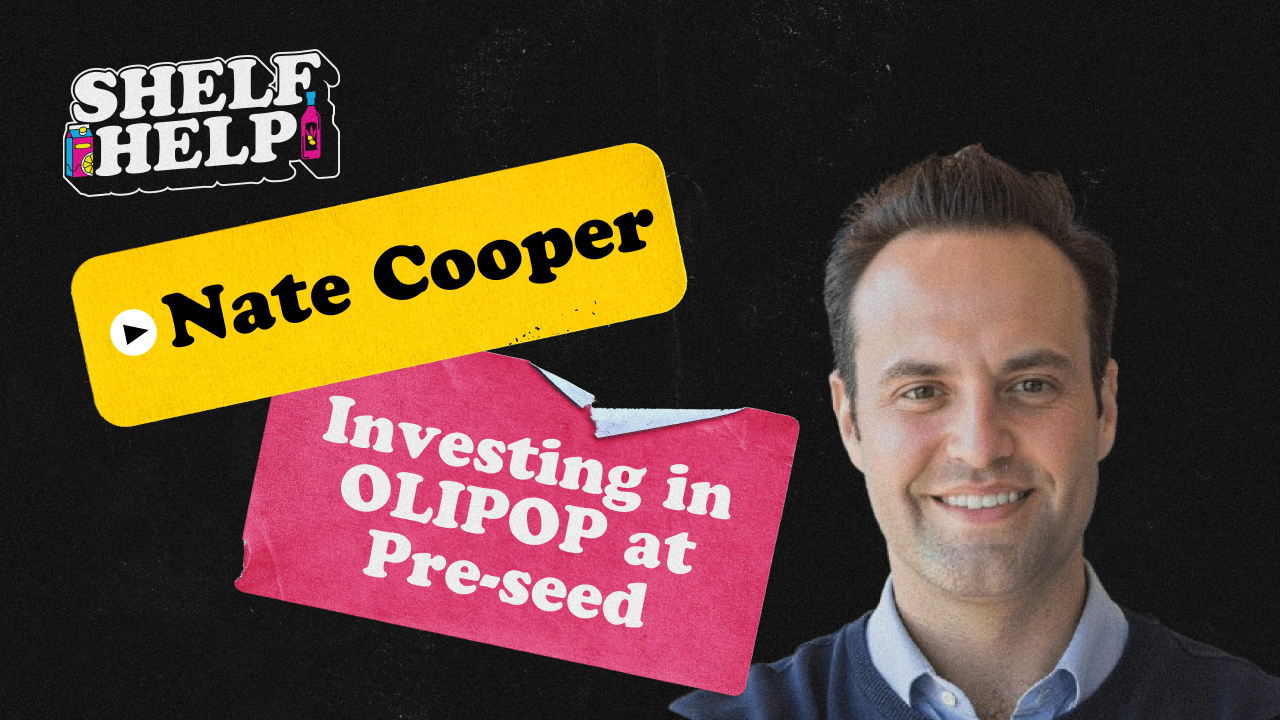



On this episode, we’re joined by Nate Cooper, Founder & Managing Partner at Barrel Ventures, and OLIPOP pre-seed investor.
He tells the story behind investing in OLIPOP at pre-seed, what changed between the early brand and the rocket ship it became, and the hemp beverage bet he believes is far bigger than most people expect.
Nate unpacks why venture is not a fit for most brands, what founders with no operating background consistently miss, and how to raise around milestones instead of “months of runway.”
We also get Nate’s high-level investment checklist and some advice for breaking into consumer VC.
—---------------
Episode Highlights:
🧭 Venture as a tool: when to raise equity vs. when to use debt
🧵 Upstream excitement: ingredients, packaging, and infra that remove friction
🥤 OLIPOP at pre-seed: conviction, category, and the early brand arc
🌿 Why hemp beverages may be a much bigger wave than expected
🧾 Nate’s investment checklist: shelf benchmarking, unit economics, repeat, team
💸 Fundraising that works: milestone-led plans, realistic pricing, exit math
🎯 Careers: how to position yourself for a role in consumer VC
—---------------
Table of Contents:
00:51:28 - Intro to Nate and his path into CPG
02:06:05 - Investing in Olipop at pre-seed
05:22:29 - What investors with no operating experience miss
08:17:27 - A tale of two cities when it comes to fundraising (or not)
10:22:27 - Upstream excitement
12:40:27 - Easing friction is the key
14:34:01 - Investing in a product you don’t personally enjoy
15:26:11 - The biggest opportunity in CPG right now
21:04:18 - The bet Nate made in the hemp beverage category
23:54:09 - Nate’s investment checklist
26:36:17 - The early Olipop brand (not great)
27:23:16 - What founders have to get right to have a successful fundraise
29:51:03 - How to land a role in consumer VC
—---------------
Links:
Barrel Ventures – https://www.barrelvc.com
Follow Nate on LinkedIn – https://www.linkedin.com/in/nathan-cooper-2ba9aa19/
Follow Adam on LinkedIn - https://www.linkedin.com/in/adam-martin-steinberg/
For help with CPG production design - packaging and label design, product renders, POS assets, retail media assets, quick-turn sales and marketing assets and all the other work that bogs down creative teams - check out KitPrint.
Episode Transcript
Speaker: 00:00
I think this will be uh the single largest consumer category that three years from now we look back on and say, holy shit, like where did this come from?
Speaker 1: 00:10
Welcome to Shelf Help. Today we're speaking with I think one of the most highly sought after early stage CBG investors in the space today, Nate Cooper, founder and partner at Barrel Ventures, based out of Chicago. Nate invests in everything pre-farm to post fork, meaning everything from ingredients and packaging all the way down to your traditional consumer-facing brands. So excited to get into it. Yeah, Nate, maybe just first off, the listeners that aren't familiar with with you know you and Baraventural Ventures, just give us a quick lay of the land in terms of kind of your focus, core thesis of the firm, and maybe just going a little ways back and what led you to focus your career on CPG in the first place.
Speaker: 00:50
Yeah. So I grew up in the food industry. I am the generation four of entrepreneurs in and around food. My great-grandfather, grandfather, and father, you know, all very successful businesses in and around food. And I always told myself I wouldn't work in this industry, and uh I've never left it. And so, you know, I was an entrepreneur for the first dozen years of my career. And then with my company Wise Apple, we got screwed over by a large strategic, um, which is a story for another day, but in hindsight, the best thing that ever happened to me, and kind of became an accidental venture capitalist. You know, the first check I wrote was might end up being the best check of my career, um, which we we can get into. Yeah, we'll get into that shortly. And I think one of the reasons, you know, you said sought after must be sought after by those people who don't know me because a lot of this is luck. But I think one of the reasons you know we've had success here is because I don't have traditional training of you know venture capital. I'm an operator at heart and I like to get my hands dirty, and I don't know any better than to try and add just a massive amount of value through us and our our network. And we've been really fortunate to invest in a lot of people who are much smarter than us.
Speaker 1: 02:05
Love that. You mentioned the the first investment might be your most successful of the career. Got to ask that one out of the gate, as I'm sure, especially people that are familiar with you, that's something that's that's top of mind for anyone that's listening. So, yeah, you you invested in Alipop at, I believe, pre-seed that early. What did you see? What gave you that strong of a conviction to write that check that early?
Speaker: 02:28
Yeah, so I had David Lester over to my house for dinner seven or eight years ago at this point. And he he walked in, and my wife goes, Hey, I made chicken, and he goes, I'm vegan. Uh and she goes, Well, we're starting off the wrong foot there. Uh and he brought three cans over. I'm not even sure. No, no, they had logos on them. Uh, it was the strawberry vanilla, the cinnamon cola it was called then, and the lemon ginger. Uh, and my favorite part is he left, and my wife goes, That was disgusting. Please don't invest. So I get to hold that over her head forever. But I like I distinctly remember trying the cola and like closing my eyes and feeling like this tastes like a diet cook. Right. And so my thesis at the time was you know, this is 21, I think. You've got kombucha, which, you know, over the past decade before it became a billion-dollar category, which millions of people would love to drink for its functional benefits, me included, but don't because it tastes like crap. Sorry. And on the other hand, you've got tens, if not hundreds of millions of people who want to stop drinking soda, but can't because it's addictive, there's nothing that really fills that gap, etc. etc. And this was kind of that in my head was the perfect thing that sort of fit both of those need white spaces. And I sent it to 30 people. You know, I I I had never really written a real check at that point investing, didn't know what I was doing. I was an entrepreneur. And every single one of them said no. Uh except for one friend of mine. And I was like, at that point, I was like, I don't I don't know if I'm gonna do this. Uh and thank God I did. And then the rest is history.
Speaker 1: 04:18
What even though you had all those no's and you just had that one yes, what was the number one factor you think you just said, you know what, I'm doing this anyway.
Speaker: 04:26
There was a coolness factor of it. You know, I think for me at least, when I talk about investing the tangible products that people can actually touch their hands on and taste and see and feel, it's much more fun to talk about those, even if you know, even if some of them might not be the biggest or most successful, just because people understand it, right? If you talk about some software thing or some ingredient or packaging, like the average Joe in middle America, you know, is not gonna know what that is, right? And then I just had this gut feeling, you know, when you when you look at soda and carbonated soft drink, it's you know, it's the biggest category in the world that the last real innovation was like Diet Coke, right? Yeah. And it was ripe for something. And we bet on the right horse.
Speaker 1: 05:12
Yeah, seems like we did. You made the right bet. You definitely made the right bet. You were definitely an operator before you launched barrel. That's how you seem to generally approach the the investing side. What is what would you say early stage CPG investors that that don't have any real operating experience often miss in terms of deals they pass on, red flags they miss, those kinds of things?
Speaker: 05:38
I think like operating in a CPG company and selling a product to consumers you learn to figure out what people's wants and needs are, you need to go in the house, you know, go into their homes and interview them and figure out what the jobs to be done of your product is. And if you look at some of the big bets that went wrong in the past decade in this category, I think, you know, the quote unquote fake meat and the lab grown meat thing, I think is one of the big ones, you know, that a lot of these massive, you know, non-traditional CPG, you know, legacy venture firms made, and they put hundreds of millions, if not billions, of dollars into this category. And I think at the core of that, you had two things. One was the product might not ever be scalable at a price that is, you know, price parity or even near it. And two, which is even the bigger problem, was consumers might not ever accept this, right? And so underwriting for execution is one thing, right? Underwriting for execution and consumer acceptance is another, right? And so having both of those be big question marks, you know, in my like, which is why we kind of avoided that space.
Speaker 1: 06:56
Yeah. That makes a lot of sense. Are there any deals that um you think you you might have skipped out on if you didn't have that operating experience ear earlier in your career that you came across? I'm gonna take a flyer on this one anyway.
Speaker: 07:10
Any deals?
Speaker 1: 07:12
If none come to mind, that's all good too. I can't.
Speaker: 07:14
None come to mind. There's there's probably ones that I pissed that I passed on uh that I shouldn't have, many. Um, I think one of the things that's been really challenging for me, you know, as an operator without having the venture training, as an operator, you you look at things and you're like, okay, what could go wrong? Right? There are with any business, there's a list of community things that could go wrong. And if you look at a venture capital deal from the perspective of what can go wrong, you will find a million reasons why not to do any investment. As a venture capitalist, you have to flip it on its head and say, okay, what if everything goes right? Right? How big could this be? Which is a very still to this day is very challenging for me because I'm a risk-averse person by nature, right? And you know, I look at things and I say, okay, what could go wrong when like in venture you have to totally flip that on its head and say, okay, what if everything goes right? How big?
Speaker 1: 08:16
Yeah, that totally makes a lot of sense. If you just go look at the average CPG-focused uh LinkedIn Twitter feed these Twitter feed these days, at least from my point of view, obviously everyone's feed is different, but it feels like it's kind of a a tale of two cities to a certain extent. Meaning it seems like I see, you know, resurgence of exits and and big raises happening, whether we're talking about Ciette or the other Alipop name, I won't say. Uh, you know, run's raising at 500 million, but then also a lot of operators somewhat scraping by, struggling to raise. I guess whether we're on this, whether you're on the same page here or not, I know this is a broad question, but kind of reflecting on that, how would you describe the state of CPG today?
Speaker: 09:01
The the Gruns, the Cietes, the Simple Mills, the Ollipops, the Poppies, the RX bar, they get all the headlines because they're the big exits. There are hundreds of smaller exits that have happened, right? And I think everyone builds to be, you know, those $500 million plus exits when in reality you should be building like the vast majority of CPG companies, you should look at a $50 million exit as a home run, right? And if you build for a $500 million exit and you sell the company for $50 million, you look at it as failure, right? But like just build a great business and try to operate it efficiently from the start. And you know, venture capital is a very specific type of medicine, right? That the vast majority of CPG companies probably should not take, right? And once you take it, like you kind of got this binary outcome in the most cases where it needs to be really big, depending on how much money you raise. But I think founders should sort of figure out how do we optimize for a $50 million exit and make that a home or even smaller, right? And I think everyone has sort of seen these big exits and thinks that's what I need to be to be successful. And that's the that's not true.
Speaker 1: 10:22
Yeah, that's super helpful. I've heard you talk about it a bit. You seeming to be uh have a lot of excitement around you might call it the top of the supply chain, infrastructure, ingredients, I don't know, fermentation, some of those things. What what are you most excited about right now and this part of the supply chain? And why do you feel like innovation at this part of the supply chain can really create, I think I've heard you say outsize outcomes.
Speaker: 10:46
Yeah, so if you look at, you know, let's look at the past 20 years, right? There are ingredients that have come up, you know, that if you look at pre and probiotics, right? Colostrum, collagen, you know, 20, 25 years ago, nobody had any idea what those were, right? Now those are all multi, multi, multi-billion dollar categories. And so, you know, we have an investment in a company called Helena, which is using precision fermentation to create uh lactoferin. And I sort of look at this as like imagine if one company owned the IP to create probiotics or you know, collagen or things like that. Like that's what this can be. And so, you know, that's how big I think something like that could be. There's also the opportunity to future-proof commodities, right? So before the war in Europe, nobody knew that a massive proportion of wheat came from Ukraine. And then when you know there's global disruption like that, it causes spikes in commodities. Look at what happened in cocoa. Everyone looks at cocoa right now and says, hey, this is a moment in time, but if you talk to anyone who knows this, cocoa's not coming down any anytime soon, right? There's deforestation, there's climate change, there's child labor, there's you know, an influx of supply and demand that isn't going anywhere. There's products that are cheaper and more profitable for the farmers to make, you know, than cocoa. And so these, you know, whether it's Mondalais, Barry Calavo, Mars, whoever it is, like they are looking at five years from now and saying, holy crap, like we need to figure out, we need to future-proof our supply chain of cocoa. And whether that's you know, synthetic, whether it's, you know, we have a portfolio company called CelesteBio, which is you know, using self-cultures to make cocoa derivatives, like they need to figure out what their future looks like, or they're not going to have a future. Or the price of a chocolate bar is gonna be like $7, right? Right.
Speaker 1: 12:41
You've said that the secret to building a successful business is easing friction. Can you share an example or two of who has or or is doing this really well?
Speaker: 12:56
Yeah, so I think obviously there are always outliers that don't fit the model. But if you look at a lot of the world's biggest businesses over the past 20 years, they're not creating, you know, massively new ideas. Look at Uber, taxis and limos existed, right? Look at Alipop, healthy soda existed, and you can go on and on and on. What they're doing is like making it easier for you to achieve something that you wanted, right? Uber made it, you know, calling a cab as quickly as you know, clicking a button, right? Alipop made a better for you soda that didn't taste like crap, right? And there are hundreds, if not thousands, of examples where like everyone thinks they need to reinvent the wheel. You don't need to reinvent the wheel. Ciette, right? Tortilla chips existed. They just made it better for you. They made it permissible indulgence, right? Or X bar didn't reinvent a protein bars. They marketed it better and made something that had better ingredients, right? And time and time again, I think the best business ideas are not, you know, because if you change too much or reinvent the wheel, there's you're trying to change consumer behavior and you're trying to convince consumers need something that they didn't even know existed. If you make a small tweak, and David Lester, one of the co-founders of Alipop, said this very well, and it'll always stick with me. You can change one or two things. You got to keep everything else the same. If you change too many things, you confuse consumers, you scare them away, you're never gonna get them. Change one or two things, like you've got to shut up building a really big business.
Speaker 1: 14:33
That makes a lot of sense. A few weeks ago, you tweeted about your hate for matcha, really popular category trend at the moment. I am 100% right there with you. I don't understand it. Have you invested, or like, would you ever invest in a brand that checks a lot of the boxes, but they're in a category or just their the flavor, whatever you personally don't enjoy?
Speaker: 14:58
I would say never, you know, because I I recognize I'm N equals one, but if I don't like it, I I'd say there's a much higher likelihood that I won't invest because then I like I'm not as excited about it. But I think that's that's hard as a, you know, most of what we do is consumer stuff. And I'm inevitably the first one that tries it, but I try to give what I try to a wide variety of people as well because I recognize that I am N equals one. And I do I do hit matcha and I've tried a million different kinds of I've heard you say that the hemp THC beverage category is the biggest opportunity in CPG right now.
Speaker 1: 15:33
Why is it the biggest opportunity right now from your point of view?
Speaker: 15:37
Uh so I'm sure you've seen some of the data. Uh alcohol, I think something came out last week. Lowest recorded consumption, you know, ever. I think between Whoop, Oarring, and Apple Watch, I think they inadvertently have like actually decimated alcohol. I think GLP1s have had a bigger effect on alcohol than any other food category. And I think GLP ones are actually being studied as a treatment for alcohol addiction, you know, and addictive behaviors. Yeah. Um, and I'm sure people people see in the onslaught of these non-alcoholic beverages like Partake and Athletic and a bunch of others. I think at the core of it is that people still want to feel affected, right? So people are more conscious of what they're putting in their body, they're more conscious of how alcohol makes them feel and the bad things it does to their body, thanks to whoop or ring and apple watch and things like that. And, you know, with the passing of the farm bill, what you have with these HemTHC beverages is something that gives you the benefits of alcohol, the social lubrication, feeling a little buzz, without any of the downside, right? Without the hangover. And I don't know if you've been in a liquor store recently or in a state where it's legal, but and I'm saying this as someone I've never smoked a joint, I've never had a gummy in my life. So the hurdle for me to try this was very, very high. But a month ago, these liquor stores had a shelf of this stuff, at least where I live. Now they have an entire aisle and they say they can't keep it on the shelf. In Minnesota, some stores are saying it's making up 15 to 20% of their liquor store sales. You multiply that across the country, and yes, there is a non-zero chance that this gets banned. I would put that at a very, very slim chance. You multiply that, call it 10% of alcohol sales across the country. That's a what $50 billion category that didn't exist a few years ago. I am convinced there will be multiple multi-billion dollar brands in this category. We've made our bet and uh nowadays. But I will say I've never seen an uptick of a category that's grown this fast. I've never seen the quantity of brands that's gotten to, you know, a decent size scale of $30 million plus this fast. I've never seen retail acceptance come this fast. I've never seen consumer acceptance come this fast. The amount of people who are willing to talk about this and try it in public, and I is unlike anything I've ever seen before. Even, you know, even in cannabis legal states, right? This, I think it's because beverage, if you look historically, you know, across millennia, beverage has been the vessel through which consumers get caffeine, alcohol, you name it, vitamins, medicine, right? Yeah through liquid. And I think it's that there's something more socially acceptable about a smoke, about drinking a beverage than there is about smoking or eating a gummy, and it's more social. And so I truly think that this could be the next, like absolutely massive consumer category. Yeah. I think this is going to be bigger than anyone imagine.
Speaker 1: 18:41
Yeah.
Speaker: 18:42
It's wild to be a part of. Just seeing seeing the numbers and the data, it's really fun and really wild to be a part of.
Speaker 1: 18:48
Yeah. I I built a a brand in the regulated THE space in also one of what has turned out to be one of the most challenging markets in California. So granted, I'm a bit jaded to a certain extent, but how do you account for regulatory and political uncertainty, especially now at a time when things to be shifting pretty d quickly in in all directions, depending on the state that you're looking at?
Speaker: 19:11
So, first off, it's scary as shit, right? The rules are changing on a daily basis. Every state is different, it's very challenging to keep up with. I will say though that a lot of what we do in venture and we as venture capitalists is binary, right? This is either going to work or it's not. I think I got the feeling with with nowadays this brand in this category that if this does stay legal, and you know, there are people, I'd say 99% of people are more experts than I am, again, because it wasn't historically a user of this stuff. I have more confidence that this will be a $10 billion category if this does stay legal than anything else I've ever seen. Like I it's just I don't know if you've been into a liquor store in Minnesota like since you moved there, but just talk to the store owners and they've never seen anything like it. Yeah. They're the amount of product that these stores are now carrying in in the states where it's legal is as if whiskey was invented yesterday, right? And the demand for it is just through the roof.
Speaker 1: 20:14
Yeah, it's a wild, it's one example, but uh I know this the Surly Brewing uh guys out here in Minnesota a bit, and they started pretty early on. They launched their own MTHC beverages, and then they've also been co-packing for some other brands. And I think the volume of what their volume is now in terms of I think they might be producing more uh hemp beverages in their facility than they are beer at this point, which I know it's one data point, but that's like one example of a brewery that's been around for years and years and years, and it happened this this quickly, is it's pretty wild.
Speaker: 20:44
And I think, you know, the strategics have stayed on the sidelines till now, right? To date. I think the second that they decide we're gonna dive in, I think it's gonna be dominoes falling, and the multiples they are gonna pay for these brands is gonna be through the roof.
Speaker 1: 21:02
Right.
Speaker: 21:03
Totally.
Speaker 1: 21:04
On that front, you touched on it a bit. You invested in nowadays. Why was the conviction so strong with this team and brand versus others within the context of you know how fast this category is growing?
Speaker: 21:17
First off, Justin and Anthony are incredible operators, they're incredible leaders, they're incredibly humble, which is really important to me. They're, you know, I look at these, first off, we invest in people, right? And I sort of say, hey, would I go work for these people? Would I go spend time with them, you know, put myself in the trenches with them? And I yes, yes, yes. I at first passed on it. You know, I never tried anything, I wasn't didn't know about the farm bill, I wasn't a user of this stuff. Then I saw the numbers and they were impressive, and then I spoke to them and they were awesome. And then I tried the product and it blew me away. And no one likes drinking or like drinking, collect whiskey and things like that. This has replaced alcohol in my house ninety eight percent of the time. Um, you know, and I've got a whiskey collection that I don't know what I'm gonna do with now. Um and yeah, we're so far we couldn't be happier. That's awesome. And I think also, you know, one thing that they've done better is they have a spirit bottle, they all sort of can everyone else's launcher with an RTD. First off, I think their brand is very approachable, you know, by a mainstream, you know, non-cannabis, non-CHC user, um, which is one of the things of how you build a massive brand, right? You go after the mainstream consumer who wouldn't, you know, normally touch a brand that says, you know, cannabis this, cannabis that, cheat and chung, whatever it is. Um the other thing with their spirit bottle, it's as if you know, you go to a liquor store and they're only selling beer, and then all of a sudden Gray Goose is there, right? Their form factor differentiation is like so eye-catching because there's nothing else like it.
Speaker 1: 23:00
Yeah.
Speaker: 23:01
Yeah, that's a good point. And it is the single best housewarming gift I think I've ever given. And people display this on their bar carts like it's a super high quality bottle of wine or a collectible bottle of whiskey, and you know, it looks great.
Speaker 1: 23:14
Yeah, that's great. That's awesome. Yeah, all those points make a lot of sense. I read a few small like angel checks here and there. Some of the key things are top of mind for me, or the founder of the team. Does the product taste amazing? Is just the overall product experience really good? Are the unit economics there? The velocity numbers heading the right direction, and are they promising? And something that you kind of touched on a little bit earlier, but positioning a bit differently. Like, does the brand have a clear place in the shelf? Is it clear what kind of section aisle will slide into? They're not trying to do something that's so new that retailers don't know what to do with it. Um I'm curious from your perspective, you're obviously much more of an expert in this than I am. What does your high-level checklist look like?
Speaker: 23:59
I think consumers need to be able to benchmark a product against something, right? Because if there's nothing that they can benchmark against, like it doesn't fit into a place in their brain and it'll confuse people.
unknown: 24:11
Right.
Speaker: 24:11
And so that goes back to like you can change one or two things, but if you change too many, like I'd rather invest in an incredible team with a okay product, right, than a incredible product with a shitty team. I much prefer people in teams that, you know, when they go do interviews, it's we, us, than I, me, right? I think humility is really important in the industry because it's really easy to get knocked off your high horse really, really quickly. I like people who are solving a problem they've faced themselves and who have this like obsessive, compulsive desire and want to fix that problem. Because I think, you know, going back to their first conversation, there's gonna be a million things that are happen that will happen when starting a business in this industry that will make you want to give up.
unknown: 25:07
Right.
Speaker: 25:07
And there's gonna be a million things that go wrong, and you have to be able to keep your eye on the future and be like, okay, well, what if everything goes right? And when David when David and Bed Star Alipop, you know, I remember saying to my wife and my partner, my dad, look, if these guys ever get to $50 million, it's a home run, right? Now they're doing that a month, right? I remember, you know, thinking, oh, we did you know close to a million bucks in the first year. It was amazing, right? Remember, we had our first million dollar month. When you start to compound these things and scale, it's pretty crazy uh how big they can get.
Speaker 1: 25:43
Yeah. In a in a really crowded market like bars, I guess now prebiotics soda, obviously you got in much earlier, but bars seems to be a a a good category to look at. What do you need to see to write a check from a differentiation standpoint, let's say?
Speaker: 26:03
Bars are my protein bars?
Speaker 1: 26:05
Might apply the same, they just need to be better. But yeah, I'm curious if anything's like different, I guess.
Speaker: 26:09
So I think there's, you know, there's brand and there's product, right? You have an incredible brand. People try a product once, right? If your product sucks, they'll never try it again. If you have an incredible product, you'll get the repeat. And so like the unicorns where I get really excited is the this companies that have an incredible product and incredible brand at the same time. Uh I think both Olipop and nowadays check those lists. When I met them, um the brand and product tasted exactly the same as it does today. But a month before that, they had another brand that they scratched right before launching. I can say this with full and if you go back on their Instagram, you can find their old brand full confidence. If they had launched with the old brand, the brand would have failed. The company would have failed. Um, and look, scrapping a brand that you spend tens of thousands of dollars on, you know, two months before launch may sound like a terrible idea.
Speaker 1: 27:09
Um but when it works, it really works. Totally. That makes sense. Shifting gears a little bit for early stage founders that are actively raising, about to start raising in today's market. What are the most common ways in which you see founders shooting themselves in the foot?
Speaker: 27:31
The most common ways in which founders shooting themselves in the foot know your numbers. Don't get discouraged, right? There's gonna be a thousand people who say no, and all it takes is one to say yes. And that's the same thing with sales, with things like, you know, I remember I think Target said no to Olipop for two and a half years, three years before they said yes. And now Target, the numbers that you there are wild, right? Be able, I think storytelling is one of the most important skills that these founders can have, right? So everything you do, whether it's fundraising, whether it's selling, whether it's hiring, like you're all you're telling a story. Everything that you do is telling a story. So be it know your story inside and out. Yeah.
Speaker 1: 28:10
I think I've also heard you talk about or say something along the lines of how operators should reframe the question from how much should I raise or or how much money do I want, to something more along the lines of what's the next milestone or two I need to hit and how much do I need to get there. Can you expand on this a little bit for some of those operators that are listening and maybe this could be helpful for?
Speaker: 28:33
Yeah, look, I think fundraising in general is like uses this vanity metric, you know, where everyone's like, if I raise 5 million bucks, I raise 10 million bucks. I care less about how much you raise. I care more about like, what have you accomplished? Right. I'm much more impressed by someone who's raised no money and built a really big business than by someone who's raised a lot of money and built an okay business, right? I think raising money in venture capital is sexy because it's you know the invoke thing to do. If I was a founder, I'd much rather bootstrap than raise venture capital and much rather fly into the radar than raise money. Like I said, it's a very specific medicine. But what would you rather have? Like look like Arnold Schwarzenegger completely natural or look like Arnold Schwarzenegger with steroids, right? Like you'd rather do it naturally, right? Because then you can tell everyone, like, this is all mine, I own it, versus having to give 20, 30, 40, 50% to someone else.
Speaker 1: 29:27
Right.
Speaker: 29:27
Totally. So if you do choose the route of venture capital, A, always raise more than you need. Like I'm gonna go on both sides here, but B, figure out what you want to accomplish and what you need to get there, rather than saying, I'm just gonna raise 2 million because that's that's the thing, right? Yeah, that's totally clear.
Speaker 1: 29:49
Last question for you, Nate. If someone with let's just say an unconventional background is dead set moving into an early stage investor role in CPG or working closely within an early stage CPG investor firm, maybe they don't start as an investor, meaning joining a firm like Beryl, who's really just yeah, willing to do whatever it takes. What should or could they do to give themselves a real shot?
Speaker: 30:18
So I will say I launched Beryl because I couldn't get a job anywhere else. Like I talked to probably 50 friends of mine who run venture capital firms, and they wouldn't hire me. Um I think people look getting a job in venture is really, really hard these days, just because it's a popular thing to do. I think the people who end up getting jobs are the people who like go above and beyond. They're not the people who apply for a job normally. They're the people who like blow someone away with like, here's my thesis, here are the companies I've invest in, here, like here's the deck I they they go above and beyond and they basically hire themselves.
Speaker 1: 30:54
You're not the first one I've heard say that. And we got a hard stop. Appreciate the time. This has been awesome. Yeah, what's the best place for people to follow along with with you and everything going on at Barrel?
Speaker: 31:03
Twitter, LinkedIn, email. I'm an open book. Happy to chat with anyone. Perfect. Awesome, mate.
Speaker 1: 31:08
Appreciate the time.
Speaker: 31:09
That's the pod.
.svg)