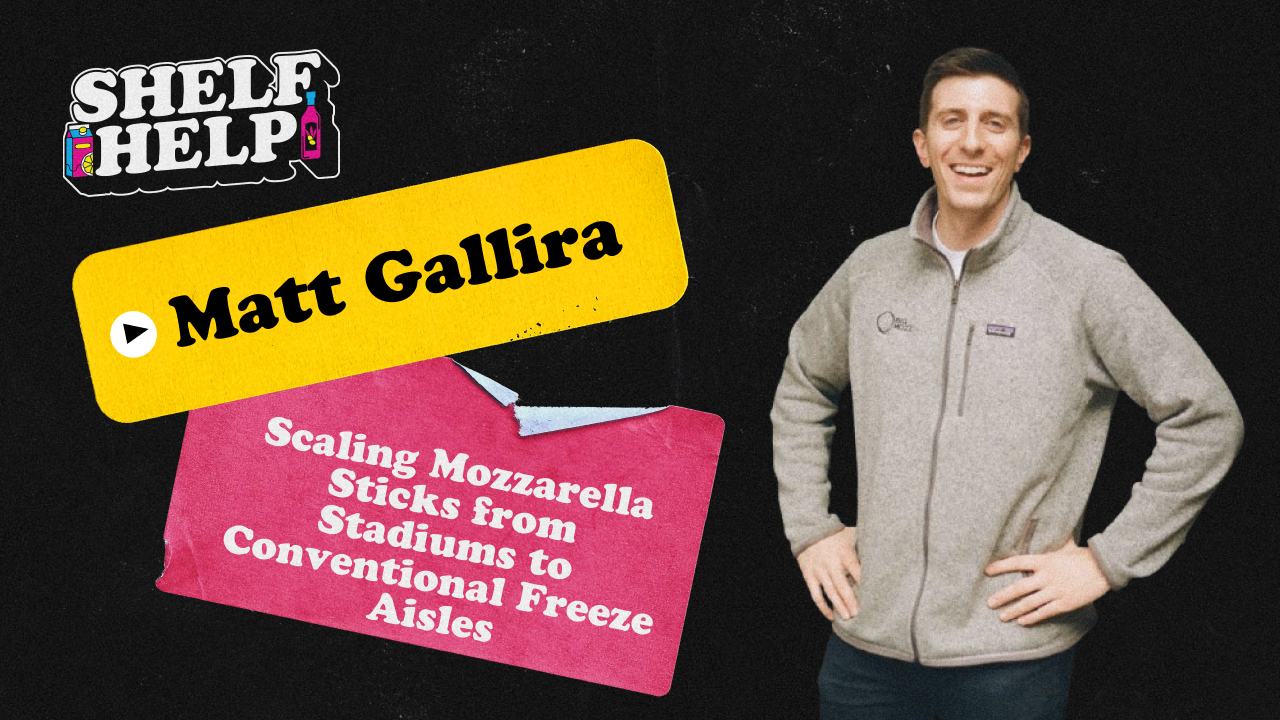
Scaling Mozzarella Sticks from Stadiums to Conventional Freeze Aisles | Matt Gallira, Big Mozz



On this episode, we're joined by Matt Gallira, Founder & CEO of Big Mozz - the premium mozzarella stick brand that started as a stadium and restaurant food service business before eventually landing in the freezer aisle.
We get into how Matt went from handmade pasta sauces to a Brooklyn pop-up tent, the in-store sauce demo where he watched a cheesemaker stretch mozzarella and he asked to work for free. Matt breaks down the original recipe and why fresh garlic one thing he won't let a co-man swap for a dehydrated version.
Matt touches on why Big Mozz launched food service first: a COVID pivot, operator-first selling to restaurants and stadiums, pitching Sysco category managers who already carry 10 mozzarella sticks, and why food service now supports the whole business.
We also dig into the jump to retail, from Wakefern to Whole Foods nationwide, reformulating for home ovens, how too many TPRs trained shoppers to wait for a yellow tag, the new packaging built to read through a frosty freezer door, and innovating around usage occasions instead of flavors alone.
---------------
Episode Highlights:
🍝 From handmade pasta sauce to a Smorgasburg pop-up stand
🚐 A van with 375,000 miles and a 150-person catering operation
🧀 Learning to stretch mozzarella from a North Jersey deli
🧄 Why fresh garlic is the one ingredient Matt won't compromise on
🏭 Getting co-man machines to do things they weren't built for
⏱️ The COVID pivot and the line trial that saved the company
🏟️ Launching food service first through stadium connections
🍽️ Operator-first selling and the Sysco "why do we need another one?" pitch
💰 Food service as the funding engine and top of the retail funnel
🏷️ Why too many yellow tags trained shoppers to wait
📦 Packaging built to read through a frosty freezer door
🍷 Innovating by occasion (one mozz stick and a glass of wine)
👀 Frozen brands Matt is watching (Jesse & Ben's)
---------------
Table of Contents:
00:00 – Intro
00:51 – Origin story: from pasta sauce to Smorgasburg
02:56 – Growing a pop-up into a 150-person catering company
04:52 – The sauce demo that sparked Big Mozz
07:34 – Asking a North Jersey deli to work for free
08:30 – R&D and the original recipe
10:12 – Holding the line on fresh ingredients at scale
12:56 – Getting machines to do what they weren't built for
13:47 – Why Big Mozz launched food service first
14:48 – The COVID pivot and a lucky line trial
16:54 – Operator-first selling and the Sysco pitch
19:06 – Food service as the top of the retail funnel
21:29 – Food service vs. retail margins and the ground game
24:58 – The food service to retail brand flywheel
28:52 – Launching retail and reformulating for home ovens
32:54 – Driving velocity: promos, Instacart and packaging
38:44 – Innovating by occasion: nuggets, Flamin' and ranch
41:38 – Frozen brands Matt is watching
---------------
Links:
Big Mozz – https://bigmozz.com/
Big Mozz on LinkedIn – https://www.linkedin.com/company/big-mozz/
Follow Matt on LinkedIn – https://www.linkedin.com/in/matt-gallira-22646529/
Follow me on LinkedIn – https://www.linkedin.com/in/adam-martin-steinberg/
For help with CPG production design - packaging and label design, product renders, POS assets, retail media assets, quick-turn sales and marketing assets and all the other work that bogs down creative teams - check out https://www.kitprint.co/
Shout out to my friends over at Glimpse, the go-to partner for automating retail-related back-office operations and unlocking margin trapped in invalid fees and manual processes.
Are you in the market for a new flexible packaging partner? Check out HD Packaging. Third-generation, family-owned and built for the needs of category leaders like Newman’s Own and A Dozen Cousins. Faster launches, lower costs, and no artwork fees.
Looking to dominate the cognitive health space? Upgrade your formula with Cognizin. It’s the branded, clinically backed citicoline trusted by top innovators in supplements, foods, and beverages. Differentiate your brand today at Cognizin.com.
Episode Transcript
Speaker 1: 00:00
Welcome to Shelf Help. Today we're speaking with Matt Galeera, founder and CEO of Big Moz mozzarella stick company that I think started as a stand in Brooklyn in 2015 is now in the freezer aisle or freezer aisle all across America. Before starting the company, Matt started a food business making handmade pasta sauces, then ultimately narrowed all the way down to one thing, which is deep-fried mozzarella, which he calls the best party snack ever, which would be hard to uh disagree with that. What I think makes kind of the storage a little bit different is in is in the the order in which Matt's built the company rather than gonna have to retail first. Big Moss really built a really real kind of live events food service business first, getting one of the serving millions of orders out of stands and trucks at a variety of places, including Madison Sur Garden, City Field, et cetera, Fenway, and then eventually turned into more package brand. So cool story, excited to dive into it. Uh Matt, just first off, just for the listeners that maybe are not as familiar with Big Moths. Love to just get a quick lay of the land, just in terms of kind of that origin story, why behind the brand, what the core product lineup looks like, and then uh we'll take it from there.
Speaker: 01:06
Yeah, for sure. Thanks, Adam. And it's it's great to meet you. And thanks for having me on. And uh man, bringing up sauce to kick this off is like a really fun throwback. And I didn't expect it. But it feels like many lifetimes ago. I've been doing Big Mots now for 11 years, and the sauce thing was kind of my way to break into food and beverage in general. Um, you know, prior to Big Mots, I like had a sales job that I wasn't any good at, and but I love to cook. And I mean, that's my advice to people starting out of the business is like, you know, just do what you love and you know, kind of let that passion and energy and like kind of you know, all the cliches around that, but like that's really important that you believe very strongly, you know, in what you're doing. But, you know, about Big Mots and and what we're doing today, and you know, like I said, I started the company, you know, over a decade ago and and you know, we've we've taken a lot of turns ever since. You know, what we're known for now, you know, and really what we believe in at our core is that, you know, as a frozen food brand, that frozen food should be genuinely delicious and satisfying, right? That at our core is what we do. It shouldn't just be about convenience and cost. We want to use simple, high-quality ingredients, real ingredients, and make everything that we do try to make it the hard way and really have, you know, kind of a reason for existing and competing in our space. And when I started the company, even though you know the business that we were in was very different, which was as you know, a pop-up stand at Smorgisburg, a big outdoor food event in Brooklyn, you know, it still holds true to what we do. Like there has to be a reason why the customer cares about what we're doing. Why should they, you know, why should they, you know, hand you any of their hard-earned money? Um, you know, why is what you're doing, you know, worthy of their time and attention and resources? And, you know, back in early days of Big Mots, it was all about, you know, stretching fresh mozzarella and you know, using real clean, fresh ingredients, same way that we do now, um, but with, you know, kind of a very different type of business. So, you know, for the first five years of the company, starting out as a pop-up stand with like a tent and a, you know, I had a van with 375,000 miles on it. And it was like a very like, you know, sort of uh grassroots sort of a start, and then growing it into, you know, a pretty big catering company. Um, we had almost 150 employees uh, you know, in our peak season by the time we got to 2020. And, you know, providing food service for outdoor events and music festivals and you know, that really became the DNA of the brands, those like high velocity, sort of high volume food service occasions. But taking, you know, and like this was peak, you know, mid 2010s of like fancy street food. We were very much in that, you know, kind of mindset of taking a category that people know and love. Everybody knows what a mozzarella stick is, right? It's you know 80, you know, some some something like 15% of restaurant menus in America have a mozzarella stick on it. It's great, it's a massive category. And everybody loves them. Like there isn't anybody who doesn't like mozzarella sticks. And the number one rule in hospitality is surprise and delight your customer. So we get to, you know, whether it's, you know, back at the pop-up stands, you know, 10 years ago, we're shipping, you know, millions of pounds into distribution, which is what we do now. It's all about taking a product that everybody has like a pretty clear expectation of what that is. And we're in the really fun position of being able to, you know, kind of blow people away and have that light bulb moment go off where it's like, oh wow, this is the best mozzarella stick I've ever had. There is a better way to do mozzarella sticks. And what we've had to do, and you know, kind of the real, you know, the hard work behind that is, you know, how to scale a business making a premium product that's non-industry standard with ingredients that are challenging to work with. And that's what I think, you know, we've figured out over the last couple of years with maybe one or two missteps along the way. But I'm just really excited for you know where the business is headed and more importantly with the frozen space and and how much action is is happening in frozen today is like it's really cool to see.
Speaker 1: 04:52
Yeah, I totally agree with that. Frozen seems to be the hot topic these days. It sounds like you you spent a good amount of time learning how to make really good, fresh mozzarella from people that have been doing it for years and years and years. Like what's and just for the people that are, I don't know, mozzarella rookies, what's unique about real like homemade top quality mozzarella that's ultimately key to making a really good mozzarella stick versus I don't know, your run-of-the-mill mozzarella?
Speaker: 05:19
Yeah, totally. I mean, that was like the light bulb moment for me. And and it started, and and I'm glad you brought up the sauce thing because, you know, back when I was doing that, that was my you know, first entry into the food and beverage space and learning, you know, manufacturing and food safety and uh graphic design and marketing and accounting and all the things that go with it. Um but you know, I was making the product basically myself and rented commercial kitchens and going out every weekend uh and doing demos. And I try to fit in at you know, three demos uh on the weekend. And I was at a store in North Jersey and I watched somebody make, he rolled in a cart, he stretched fresh mozzarella, which is you know, starting with cheese curd, you're you know, salting it, pouring hot water on, and like you're doing these big kind of like heroic stretches all the way up to the ceiling. And he would like really play it up, and there'd be some like, you know, it's it's very theatrical. Um, but he's talking to his customers as they're walking up and he's kind of taking them on a journey. There's some education that happens there. Um, so I'm sitting, you know, standing there, you know, kind of doing little samples of tomato sauce, and like, you know, I'm pretty excited about what I'm doing. And I'm watching this guy like engage with his customer in such a direct way. And when most of my time is spent in, you know, a like a hot kitchen, like making tomato sauce for most of the week, and you don't have that satisfaction, like kind of satisfaction of like serving someone, the food that you're making, that's when I realized that like at the time for me, CPG was not it. Like doing tomato sauce was like was cool. And I I I you know I saw like a pathway toward doing it, and you know, I was very passionate about it. Still am. But you know, being able to, you know, very directly be in in in the the food service business as an operator and cooking something and handing it to someone and you know, seeing that like moment of of pleasure that happens is just like you know, what I found really gratifying about you know what or uh the the food space in in the first place. So, you know, I saw this guy making mozzarella cheese. I'm like, all right, I've got to do something with that. And also like I grew up in New Jersey and like I've eaten like an outrageous amount of mozzarella in my life, and I didn't actually know how to make it or where it comes from or anything like that. So, you know, I I watched a lot of YouTube videos uh on how to make mozzarella and I learned all about it. Uh and you know, then I went to a deli in North Jersey that was famous for making, you know, the best mozzarella, and like everybody's got one of those. And I was like, hey, like this is a weird request, but I think you make the best mozzarella. Like, can I work for you for free? And the guy was like, No, uh, but like come in the back, I'll, I'll, I'll like, that's all weird. Like, I want you out of this store as quickly as possible, but come in the back, I'll show you what we do. So he taught me a little bit how to stretch, he told me where to buy curds, so I bought a you know, case of mozzarella curd, started playing around with it, and then started to come up with the concept for big moths uh as that like you know, like education front and center, the theater of stretching mozzarella, and then working that into all of our menu, all of the items on the menu as kind of a unifying element. Um so you know, that wouldn't have happened unless I was, you know, outdoing the, you know, kind of the grunt work of like, you know, doing the demos for for the sauce business. So that's how I learned how to make mozzarella in the first place.
Speaker 1: 08:30
That makes sense. Beyond or maybe building on the mozzarella specifically, you know, without giving in any way too many trade secrets or anything, what's what else has been kind of the key variables that you were playing around with between once you learn how to make mozzarella, you decide I'm gonna start making mozzarella sticks of those first few to those, you know, whatever RD formulation process looked like to the point where you had that final mozzarella stick. You said, okay, I'm feeling great about this, I'm ready to take this to market.
Speaker: 08:57
Yeah, I I mean there there totally are. And like, and like I'm not a trade secret guy. Like, and I think what we do is is just really challenging. And like that's the biggest mote that we have around the business is you know, using fresh ingredients, using great whole 100% whole milk mozzarella, right? These are not and not messing with them too much. In a lot of ways, like, you know, our the kind of the food manufacturing ecosystem in America is like not really built to make a product that way. So, you know, all of the secret is getting to a size where and we use a co-manufacturing model where a co-manufacturer is like excited to build a process around our very unusual product. So, you know, back when I was like making mozzarella sticks, like, you know, testing them in my like apartment kitchen. Obviously, we, you know, work out of commercial kitchens that were inspected and all those things. But uh yeah, I mean, the first ones were like, you know, I would make mozzarella, you know, let it cool down, cut it into little like logs or whatever, uh, and then build the the breading out of fresh ingredients. And that's like classic like Italian bread stuffing, like or whatever like goes into meatballs. It's fresh garlic, parsley, peppering and remotto cheese, salt, pepper, and breadcrumbs. And that's what was on the first Big Mott sticks, and that's what's on them today. And the challenge is that as we scale, not messing with that too much, right? Like you always have the push and pull of a manufacturer who wants to get their throughput higher. Yeah. And they're gonna change, you know, how the cheese gets onto the belt of the many uh of the line and you know, how the breading gets applied to the product, and you know, kind of what all the different layers of it are. That stuff, like you have to, you know, be flexible on. You have to understand sort of the engineering of it and be like really in depth with the product, but then also be really inflexible about the stuff that matters. You know, blending fresh ingredients into dry breadcrumbs is like a heck of a lot easier said than done. It's really hard to do at scale. And at every step, we have everyone from finance to you know to operations in QA at uh at manufacturers being like, yeah, well, you know, what if we just replace those with a dehydrated garlic and we can add a garlic oil to get that aroma going? And it's like, no, that's the one thing I'm inflexible on. Uh I'm willing to work with the world's most expensive breadcrumbs uh by the time we blend in all the fresh ingredients. And I think that's like you have to decide and really have a North Star of like what you can find flexibility on and what is a true core attribute when you're a you know a product-centered brand in the way that we are. And then try to answer the question of like, you know, when we innovate, like how do we incorporate those product values into that? And that's something that, you know, has has been prompted real soul searching inside of the company over the last couple of years. It's like, yeah, we're called big moths. Like, you know, probably we're gonna do something with cheese in it, but like, how do we, you know, continue to innovate and make a product that's really special to the consumer and again worthy of of winning in the marketplace?
Speaker 1: 12:01
Were there certain aspects of the process that you had to hold the line on? Yeah.
Speaker: 12:06
And I I mean, like some of it is is uh you know, being a real nerd about uh, you know, kind of the equipment and and the manufacturing process and and truly understanding it. I think, you know, like uh in I went to school, I was an English major. So like I have no, you know, food or engineering background for sure, even though that's kind of the business that I'm in. And, you know, some of it is like is actually understanding like what the envelope is and what the limitations are. And they're, you know, when you're a small brand and you're looking for your first co-man or your next larger co-man, you can't just hand over the the formula and say, it's with the experts now. What they tell me is possible, that's what goes. You kind of have to push them a little bit. And remember that, you know, they're competing for your business, but also they want to make sure that their line can run for a you know a 12-hour shift or a 24-hour shift. So, you know, that's sort of the the push and pull of it. But I I I think uh, you know, it's it's uh like I think what my like core competency is as the founder of the company is like going into a uh a manufacturing plant and getting the machines to do things that they weren't built for. I think that's actually what I'm like best at. And you can only do it when you really understand like how do these machines work? Like, how does uh you know the cascading waterfall breading with the different pressure and the blowers and all these other like variables? There's a thousand variables on the production line. And what can you do that's unusual and keeps the you know, this the heart and soul of the product the way that it's supposed to be? And and again, why did customers like this product in the first place? Don't ever change that. But how can you be easy to work with and flexible and make it so that the line can run for for 24 hours a day is like kind of the big on lot there?
Speaker 1: 13:48
Let's talk food service. Um obviously put a big focus on distribution to restaurants, bars, stadiums, all the all the things that that you mentioned. Like that was back in 2022 or so. Maybe just from from a high level to start, like from your point of view, now that you've you've been in food service for a while, but now you're selling retail too, you got a bit more perspective, let's say. What what have you found is would you say are like the the big few pros and cons of the food service channel? And maybe thinking back early days, why did you decide to really focus here for quite a while versus I'm gonna go more straight to CBG right away?
Speaker: 14:20
Yeah, thanks. I mean it's a good call out because we're we're pretty unusual in that we launched food service first. Yeah and then retail followed that. I think some of it was from, you know, my restaurant as like a hospitality and restaurant person uh and kind of the you know, being true to you know, kind of the first five years of Big Mots and what we did and you know, starting to serve at, you know, some of the stadiums and ballparks that were our first real food service customers, right? And some of it is our like sort of like 2020 COVID era pivot story, right? Like COVID hit us really hard. Um, and you know, we're an outdoor, you know, eat with your hands brand based in New York City. And, you know, we went from you know all the momentum in the world and we had a you know small, but our first restaurant in Chelsea Market, and we planned to open two more and like this like 2020 was going to be our year. And then it was like, nope, hit the brakes as hard as you possibly can. And at one point the company was just me. But fortunately, because we had such a big catering business and we had started to like, you know, load up tractor trailers full of product and go out and hit all the big music festivals. And we had a team in LA, we were shipping product out there. We had just onboarded a kind of next larger size co-manufacturer in the Midwest. And I was out at that facility in the first week of March of 2020, finishing implementation on their production line. So, like finishing all the RD steps and getting the line set up and doing a line trial. And if that trial had been pushed by a week, like we wouldn't be having this conversation. So it was incredibly lucky that that happened. And then, you know, in kind of the months that followed, it's like, uh, you know, how do we keep the lights on and pay our insurance bill? And I was teaching mozzarella making classes on Zoom and like selling merch and like doing all those like scrappy like COVID era things. Uh but then I was like, okay, like, you know, we've got to get serious with this. And, you know, I've got a brand here that has built a lot of goodwill, and we have a lot of followers and a lot of people who really love and care about, you know, the the stuff that we did, you know, for the first five years of five, six years of our existence. So that's in the asset column. And I also had capacity to produce the product. So, you know, not knowing anything about CPG really and being pretty far removed from the sauce thing, which like feels like a couple lifetimes ago. It's like, all right, like we've got the capacity, we've got a brand, we've got a product that's really special. Let's go and launch food service. And so I used kind of the first uh, you know, connections that we had with some of the stadiums to get into, you know, to get coded with their distributor. And that still reflects how we do food service today. We're an operator first food service business. And that means, you know, we go out to, you know, a corner restaurant or, you know, a 500 location chain, and we say, here's the best mozzarella stick you've ever had, and the price is correct. And uh put this on your menu because it will be incremental to your menu and you'll grow your sales, you'll grow your ticket values and all those things. And the mozzarella stick category in food service is just as hot as it is uh in frozen. So that's why I started Food Service First. It was about like, okay, this is something I have. I'm gonna go and and and and you know, kind of build a market for it. And at the time, certainly, there was no market for a fancy mozzarella stick. The mozzarella stick category is owned by, you know, a couple of uh, you know, incumbents in the space who, you know, they do a great job. Like if you've had a mozzarella stick uh in a restaurant, you've had a mozzarella stick from a McCain or an Ajumoto or a Fry Foods, and these are you know billion-dollar companies, but they sell a lot of different products. They'll sell French fries or they'll sell jalapeno poppers or pickle chips or whatever it is. And so, you know, one of the pitches from the beginning, and you know, when we go into you know a meeting with a category manager at Cisco, is like, and their first question is like, guys, like I have 10 mozzarella sticks, like why do we need another one? It's well, like, here's what we're doing, and here's why our product is completely different from everything else in the marketplace. It's you know, it's not part skimmed dairy that's cut with, you know, starches and fillers and gums and whatever we can do to make it cheaper. It's not packed with breading on the outside, again, to kind of make it more cost effective. And also at the time, this is when supply chains were really tight and a lot of line time in manufacturing was switching over from food service into retail, and the throughput in retail is a lot less than in food service. So you're getting these big companies out of stock on mozzarella sticks. And here we are being the you know, specialist manufacturer of doing one thing really, really well. And we have the best mozzarella stick ever uh launching into food service. And that like kind of little toe in the door was uh a lot of the big manufacturers being out of stock of mozzarella sticks. So that was a way that you know really kind of kick-started the food service business for us. But kind of getting back, like, you know, and kind of where food service lives for us, like it underwrites the whole business. And I see it as our unfair advantage in retail. So, you know, the way that we're able to use a food service almost as like the top of our marketing funnel. You can kind of think of it that way, where like for every you know, CPG brand, you know, it starts with, you know, you know, basically just like getting impressions on, you know, socials and kind of kind of works down from there to through shopper marketing, TPR, and promo to sale to register. And we have our entire food service business selling, you know, and serving, I don't know, what did we serve last year? 30 million orders of four mozzarella stick, probably, like, you know, is is is kind of the the size of our food service business as it is now, and it's grown pretty fast. You know, that's a crazy thing that like other retail brands like would pay a lot of money for. And for us, it is the first and best introduction to the product and the brand, and it is making it so that we can fund everything that we're doing uh in retail, which is uh which takes a lot more upfront investment with slotting and you know, packaging design and and all those things that, like, frankly, in 21 and 22, I had no money for. So, you know, food service was a like a really cheap way to put the best product into the marketplace. So I think some of it was circumstance, like it was kind of the right time to launch in food service. But this is something that I tell, you know, other founders and other entrepreneurs all the time is like, don't sleep on food service. There's a lot of action there. Your customer in retail, if they want more premium, like those are restaurant operators and chefs and cooks, and those are the people who are, you know, aware of what's happening in the retail space too. They know that they need to clean up their ingredient statements and they need to serve a better product. And the consumer is more demanding than ever about, you know, removing ultra-processed ingredients and you know, frankly, serving a you know, going out to restaurants is like extremely expensive right now. So, you know, the the bar that you have to hit as a restaurant operator is higher than it and it has been because it's more expensive. So, you know, we're giving them the easiest plug-and-play way to improve one of the top selling items on their menu. And and that tends to be a a pretty easy sell. And again, it supports what we do in uh in retail and is kind of the first, you know, touch point with the consumer.
Speaker 1: 21:29
Totally. From a a um like a like a net margin standpoint, now you mentioned there's obviously a lot more costs associated with retail, you know, packaging design, TPRs, trade, all that kind of stuff. I've what I've heard from a few operators is that at the end of the day, the net margin between food service and retail is a bit more comparable than than you think because the price that the food service will take, they are just asking for a lower price, but there's obviously less other costs baked into those, all the stuff associated with retail.
Speaker: 21:57
Yeah. I mean, food service it it has a much smaller gross margin for. Sure, but there's less trade spend, you know, and there's fewer deductions, and it's overall an easier business to administer than retail is. And I I mean, everybody who's gotten into Unify and Cakey knows like those the deductions come hot and heavy. And you're like, how did where's all this money going? Yeah. It doesn't quite happen the same way in food service, but you know, with food service comes, you know, the big trade shows, and you have to be really active in selling into the marketplace. Often you're selling into, you know, a single operator location, right? You're not selling into, you know, it's one meeting at Publix and you've got, you know, 1400 locations, you know, it's it's really a ground game. So you have to be like, you know, really diligent, really organized about that. But it's can kind of happen the same way that you can grow organically in retail, which is start really small, right? Like, you know, if you live in, you know, in New York City or Dallas or whatever, like draw like a 10 mile radius around you. There's probably a hundred bars and restaurants in that area that have, you know, in our case, a mozzarella stick on the menu, just go to each one and learn and start asking questions. And, you know, odds are like, you know, the customer is going to tell you why they're going to make buying decisions and what's actually important to them. And in most cases, you know, knowing that there's an appetite for premium in the food service space that maybe didn't exist as much before, you know, they're probably willing to pay like a couple dollars more per case so that you can have those fresh ingredients and the other things that are unique about your product, you know, but it's it's all about like, how do you show the operator that this is plug and play? There's no training, special training that needs to take place for your team. Like this is just an instant upgrade on your menu. You know, it makes the buying decision for them, you know, very, very easy. And then once you've got those core couple of customers, right, then it's the job of convincing the distributor to open code the product. That means it's actually in the catalog and people can find it. That was something that we battled for the first, you know, we're still battling it, but it was really bad in the first couple of years where it's like, yeah, we get like a like an anchor customer. So we're stocked in, you know, Cisco, Connecticut or something, but nobody can find the product. Or, you know, we'll be out, we'll invest in a trade show, and you know, somebody right in front of me will call their rep and they'll say, Hey, I just have the best mozzarella stick ever. Here's the code, this is the brand, and they'll be like, ah, like that's closed-coded.
unknown: 24:28
Like you can't have.
Speaker: 24:29
Yeah. You know, uh, so it's all about like being patient, starting very, very small, getting critical mass in it in an area and building a a reputation, right? And it's like a lot of this still, like, you know, in retail and food service, it's a reputation business. Like if you can show that your product is worthwhile and there's gonna be turns, it's not gonna sit in the warehouse. Then all of a sudden you start to see it kind of uh the network effects start to happen and and it starts to build from there.
Speaker 1: 24:59
Yeah, on that front, I definitely feel like I've heard from a number of people that I've spoken to that that whether they started in food service or it became a big part of the business, is that they've they've found that it can be a bit of a brand building flywheel, or like, you know, uh someone'll bus buy a you know, mozzarella stick at a stadium, then they'll see it in retail, or maybe they'll go actually look for it a meetup because they try it at a stadium and be like, wow, this is really good. Or they'll try it and see it on the menu at a restaurant, and then that'll lead them to buy it at retail, and or the other way around, love they'll be buying it at retail and then they'll see it on the menu at a stadium or restaurant and be like, oh, I I know this brand really well, have one at home, definitely gonna buy one at Edset. Something to you found. And if so, I'm not sure how easy it is to be able to actually track the journey of someone that eats you know a mozzarella stick in Madison Square Garden, which leads them to purchase at retail. Whether you've figured figured out actually track that or not, have you generally found that that's kind of accurate from a flywheel standpoint?
Speaker: 25:48
Yeah, that that's a really interesting idea. And I mean, it's one of the one of the downsides of food service is often those sales are unbranded. Right. So you know that like as your your you know scale grows, your volume grows, right, you're getting more line time with your distributor, you're getting more or a co-manufacturer, you're getting you know more purchasing power and negotiating power with all your suppliers, your costs can come down. That's what food service did for us, right? If we hadn't launched food service first, then you know, if I tried to go straight into retail, we'd be on shelf, you know, at like $12 in a category that can support like seven or eight. So right, that's what food service really did. But you know, as far as what it does for the brands, this is something we work really hard on and is a renewed focus for us, knowing how powerful brand is in the food service space. How do we get the consumer to understand the journey from a partnership with you know the Phillies or uh you know the flyers or like some of the other teams that we have, you know, branded partnerships with, right? They get the best first impression of the product, they have the sense memory happening of like, wow, I had it was you know, branding on the on the wax paper on the boat, we're up on the jumbotron, like we're getting announcements over the PA system. Awesome. That's all part of the like the partnership spend part of it.
Speaker 1: 27:06
Yeah.
Speaker: 27:07
And then like also, it was the best mozzarella stick I've ever had. So, like, you know, that's that's a win every time, as soon as we can get the consumer to try the product. And then they walk through the aisle at you know, a Whole Foods or a Wegman's or a Giant Foods, and they get fired up to see it on shelf. Like that's that journey we know is happening. It's pretty hard to track, right? Data and food service is pretty hard to come by. The data that exists is really expensive and it's like not as robust as what's available through, you know, spins and circana and and everything on the retail side. So often, like, you know, our products, we know that we're gonna send, you know, 100 cases into you know, PFG, Little Rock, Arkansas. And I have no idea where the product goes after that. Uh so for us, it's all about engaging with the operators, going out to trade shows when we hear, hey, like, you know, oh, like uh, I've been a customer for two years and it's like awesome. I've never heard of your restaurant ever, but thank you for your business. This is so cool. Can we connect after the show? Um, and then it's hey, how can you use the brand, right? Have big mozzarella sticks on your menu. Use the brand there as a markup quality and to you know show the customer kind of what they're getting into. You can probably command, you know, the higher price point that gets your food cost to where it was when you're you were using a less expensive product because people are willing to pay for a branded product that is higher quality. So, you know, that's one of the things that we're using food service for is to help with our like unaided you know awareness. And it's one of the things that we know that we need to probably do a little bit of a better job tracking, but it's it's uh it's a big part of the job for us. I would say right now, like maybe 20% of our food service business is branded, but it's really hard to know what that number is.
Speaker 1: 28:51
Yeah, totally. Yeah, that makes sense. Well, eventually eventually you decided it's time to expand into retail. How did you know it was the the right time?
Speaker: 29:01
I didn't know it was the right time. I had good advisors uh who told me it was. Okay, fair enough. Um and I was like, retail, what's that? Because for me, it's like, you know, the the the the size of the market and food service is so big and you know, we were getting such traction. And I was like, retail is gonna be so expensive and so distracting. But really, it's like, you know, how are we, you know, how we're building a brand here. And if we're gonna, you know, be something other than a mozzarella stick at some point, right? There needs to be a brand underneath that that communicates the, you know, the attributes and the specialness and you know, uh, you know, all the qualities that we have very clearly to the consumer. And we had already started to do that, right? Like, you know, pre-COVID, all of our sales were fully branded. And so is there an opportunity like just launching into, you know, into retail where we can use our food service business as, you know, kind of our unfair advantage on the retail side. So, you know, when we launched into retail, it's effectively the same product as in food service. It's, you know, there's like a par fry step in manufacturing. So it's fried first, then frozen, par fry for a little bit longer so that it can cook up in a home oven. But that's one of the really tricky things, right? Even though our product is very similar or like basically identical, the way that the consumer is cooking and serving the product is like outrageously different. It's food is always going to be better out of a deep fryer than it is in like the worst home conventional oven.
Speaker 1: 30:29
For sure.
Speaker: 30:30
And that's what we have to design the product for. So over time, there's you know, process changes and and the you know, the different you know, steps in the coating and everything, the ingredients are the same, but you know, how do we make it, you know, really, really perfect and bulletproof um for the home consumer? Um and if we hadn't had a lot of shots on goal in manufacturing with the food service product, if we had tried to do that in retail and just made a mozzarella stick the way that everybody makes mozzarella sticks with our kind of weird coating and our coating is also like classically like very thin. It's a lot less breading compared to the amount of cheese, it wouldn't, it would not have worked. It would have gone really, really poorly. So, you know, that that was another way that, you know, the the experience and all the learnings of food service was was effective. But yeah, like starting around 2023 was when, you know, it was clear that something interesting was happening in the frozen aisle. There was more brand discovery happening than ever before. There's more premium happening in Frozen. That's still the case today. And sort of the consumer, or sort of the the you know, the kind of the behaviors and the buying trends have changed, right? Frozen isn't about you know, convenience and the lowest possible cost. It's about convenience and quality, right? It's those two things coming together and not convenience and low, super, super low cost. So, you know, I think there's there's a limit to that for sure. Like, you know, like I said, like we couldn't be on shelf for 12 bucks when everything else is seven, but like, you know, if we could get on shelf for eight bucks, nine bucks for for a pack of mozzarella sticks that has a really, really good value, you know, then we can drive trial that way. And we know that because our product is really unique, if we can drive trial, we're you know, those are repeat customers. So uh, you know, our first couple customers were, you know, the likes of of Wake Fern, you know, in uh in in New Jersey, Sue Leonard's Wake Fern is, you know, ShopRite and uh some other banners. And then, you know, about a year later, we were in Whole Foods nationwide. So today we're you know in close to 5,000 doors. We've got some really, really big launches coming over the next couple of weeks that we're stoked for.
Speaker 1: 32:30
Nice.
Speaker: 32:30
Um but you know, it it was all about like getting the product into a small number of stores that we could like obsess over and really get right. And there was a lot that we did not get right, and just like learn all those mistakes, be very honest with ourselves about what we're doing well and what we're not, and then just make it better the next time. Yeah. Whether it comes, whether it's anything from product to how we're fulfilling it to you know how we're we're driving units through the register.
Speaker 1: 32:55
Yeah. You mentioned driving units to the register, driving trial. What from a velocity standpoint, what have you found has had has had and is having the biggest impact?
Speaker: 33:04
Yeah, I mean, I mean it's a hard it's a hard question and it's an answer that gets really expensive really quickly. And frozen is like is really price driven. Frozen is also a funny category where like, you know, it if you're doing, you know, one or two units a week, like that's probably pretty good. And that's not the case in a lot of categories. Frozen is like is a little bit slower.
Speaker 1: 33:22
Yeah.
Speaker: 33:23
So and for us having launched with one SKU, which is another weird thing to do, you know, it was all about uh promoting on price really for the first couple of years. And that's what we could really do, you know, being of an incredibly small team. And you know, the company, you know, grew was was four people in 2023 and 24. So like, you know, we we really kept it tight as far as our our corporate team goes. So, you know, there's there wasn't a ton that we could do with shopper marketing, and but we knew that our customer lives uh is typically, you know, generally higher income. They're generally uh skewed toward buying on digital. So we overinvested in Instacart and um, you know, any like retailer.com opportunity that there that there is that we could do and try try to skate to where the puck is, right? And make sure that we were presenting the product to our customer um at a price point that is correct. We know that we need to drive, you know, kind of where we may be overcorrected toward doing too many TPRs and too many yellow tags because you know, we'd do a price promotion and velocity would skyrocket and go straight back down for for you know full price sales. So that was the learning of the first couple of years. It's like, no, we should not be doing 20 weeks of promotion. We probably, you know, and now we're just training the customer to wait until there's a yellow tag. But the yellow tag is really powerful. So, you know, if our our job is to drive trial, that was a really good way to do it, you know, and like we would do uh like a BOGO at uh, you know, the the likes of a wake firm, a shop right, and you know, we would do like 50 times, like it would be like a 50x lift, like it'd be something crazy. And uh, you know, you can't do that every day and have the company, you know, survive. You have to figure out how to drive full price sales. And the way that you do that is with brand. It's by communicating, you know, why the product is special in the first place, and you have one and a half seconds or whatever to do that through like a frosty, like frozen, you know, freezer door. So that's where packaging is very important. It's telling the story, not through words, which would be like how I would do it, but like showing rather than telling. So, you know, to that end, we're launching, you know, brand new packaging. It's starting to roll out to retailers. We launched it first at HEB earlier in the summer, but now it's starting to filter out to all the rest of our customers. And like it's already driving a pretty huge, like a really measurable and huge sales lift. It's awesome. Because you know, people can look into the freezer aisle and it's like deep, bold colors that kind of show through the the frosty window. But uh it says very clearly not only is this a mozzarella stick, but like you can tell from the front of the box that this is, you know, I'm buying into something that's gonna be a really unique and a really fun experience. Like the cheese pole is sort of like table stakes and mozzarella sticks now. Um, and everybody wants the cheese pole, but like, how do we do like clean ingredients? How do we do fresh ingredients? And how do we do something that you know our our competitors are are simply not doing?
Speaker 1: 36:18
What was kind of the the reasoning behind the redesign? You wanted something that was gonna stand out more on the shelf behind a a foggy, cloudy door?
Speaker: 36:26
Yeah, I mean, it's it's being really direct with the customer that like we're we're playing in the category that you know what this is and we're doing something special in it, right? So there's no confusion whatsoever. Like, this is a mozzarella stick, and you know you like those. I certainly do. So it's it's all about being able to show that story to the consumer in a way that clicks, you know, right away. Like you have to have, like, we're called big mots. Like, you've got to have the energy on the front of pack. Like, there's gotta be some, you know, like uh there's gotta be some action there. So like that's that's what we know that the brand needs to do. Like we've got to have like the swagger out there. There's gotta be boldness and some cool factor. And like, yeah, I want to participate in what this brand is doing. Like back in the day when we were like, you know, the Smartburg and catering business, like, you know, one of our like core company values was participation, right? And what that meant to us at the time was like, you know, like kind of chef culture was like very exclusionary. Like it was like, oh, we're doing something like really fancy and special, and like we'll let you in if if you're cool enough to. Like we want to be like the access point for people to like engage with what is interesting and new in food and beverage, right? And we want to make it as easy and like you know, put up a really big tent for, you know, to say, like, hey, we're throwing a party, you're invited. And you know, that makes it like really, really easy for the you know, for for the customer to be like, yeah, like, you know, I want to give that a shot. I think like the coolest usage occasion that we figured out for our product, like obviously, like it's mozzarella stick, you're gonna put them out on like a platter at like a kid's birthday party on the weekend or something, but like my favorite one, knowing that our our customer, you know, is you know, aged like 18 to 34 and you know, is a professional living in a city, like, you know, it's the Friday night after work, one mozzarella stick and a glass of wine. Like, I think that's like the coolest, you know, usage occasion. And like, as one of the ways that we sort of tell our like incrementality story, we're not trying to just like chunk out a little bit of business from you know the farm riches and TJ Fridays who do a great job. It's like, no, we're bringing new feet into the frozen aisle through brand outside of the store and all the activity that we do. And for the people who are walking regulars down the frozen aisle, it's something new that they can try and you know bring some energy into the category.
Speaker 1: 38:45
On the topic of incrementality, um, you've gone from just the one original stick into a few different flavors. I think you've got a nugget format now too. Just from a product roadmap standpoint, what does that journey look like for you in terms of you know deciding when it was time uh to bring more SKUs to the market and then actual like that decision process to the point or some sort of checklist, imagine you go along and say, okay, all these things are making sense, lining up. There's justification here to bring this next skew to market.
Speaker: 39:11
Yeah, yeah. I I mean, innovation for us was like a real challenge early on. And uh, you know, being a one product company, it's like, okay, cool, you guys made a small one. But like as soon as you as we made a Mott's nugget, which is the same product, cut smaller, it's a totally different occasion to have the product. So all of a sudden, right, we're getting out of the like, you know, kind of premium thing and the one mozzarella six glass wine, which is still the coolest thing ever. But now it's like, okay, kids are home from school and I'm gonna pop three or four Mott's nuggets into the air fryer and they're gonna be done in five minutes, and it's a great after-school snack. So it becomes, even though the product is very similar, the usage occasion is very different. So that's now how we think about product innovation is when or what occasions are we not addressing with our portfolio, right? You know, we know that we want to be a little bit on the cutting edge. I say that, you know, sort of lightly, like you know, being a frozen mozzarella stick, but like, you know, launching flavors and launching a spicy and a ranch mozzarella stick. It's really unique. One of the dangers of, you know, adding a flavor to any core product is like you're cutting out a chunk of consumers who are like, I don't like spicy or I don't like ranch. So that's one of the dangers of doing that. But you're growing your brand block. And you know, maybe there's like the the occasion there is product discovery or trial of something new. I just want something new. Like what is the what is Harris Teeter offering me, you know, this week that's that's new that I didn't see last week? You know, so that's one of it. But then you think about different day parts. Like, you know, are we doing, you know, like we we've got like, you know, novelty snacking covered. How do we get into everyday snacking? So, you know, our innovation roadmap is all about how do we make products that are true to Big Monts? Like, how does it a recognizable Big Mots product, but also something that requires no education for the consumer? It's clear that we can apply like you know, the specialness and the brand attributes and the product attributes to a new product, but have it be that like big, splashy, fun, like indulgent thing with a clean label and being restaurant quality. Right. So, like once you like, you know, do the work and and and identify all those things, then you know, you've got the envelope that you can improvise within. And you know, the best art comes from from boundaries. So, like, you know, once we know what our boundaries are, then you know, we can really have some fun and think about okay, what is our consumer going to be interested in that we you know have the ability to act on.
Speaker 1: 41:39
You're deep in the frozen section, so you're walking on the frozen aisle every day. Other than big moths, what's one brand that you admire or think are doing a lot of really cool, good things in frozen aisle?
Speaker: 41:50
Oh my gosh, uh there there's so many brands doing it really well in frozen right now. Um I mean, one that I love is Jesse and Benz, and they're just like lighting on fire at the moment. Um, and like they totally deserve it. Like I I knew Jesse back in the Smartersburg days because I think that's where he started too. And uh, you know, like okay, frozen french fries in a bag, like where's that supposed to go? Like there there's already companies that do that like really, really well. And like, how are you gonna charge double? Or uh I shouldn't say that, but like, you know, how do you, you know, cover your costs when you're a small company doing fancy french fries? But I think what they hit on is what is the consumer after? They're after clean label, you know, they're after no seed oils, and they presented it in a way that requires no education whatsoever. Like, you know that, like, you know, and and maybe like for me, you know, I probably grew up on like frozen french fries, like, you know, cooked in the oven and you know, from a variety or whatever, and like, you know, and this is the case in a lot of uh subcategories inside of frozen, is like, you know, the consumers who grew up on those products have abandoned them because of, you know, the ingredient list that is a mile long and you know, all the other things. And it's not just about convenience. So it's like, how do you bring people back into the frozen aisle by doing something that is restaurant quality and convenient? I think they do it super, super well. You know, and there's other brands like you know, kind of, you know, looking at like, you know, what are what what of those subcategories have kind of been forgotten? Like where doesn't the innovation exist? And like I love it. I think I already said this, but like a rising tide lifts all boats. Like we need more cool brands happening in Frozen. And like we're not the first mozzarella stick, like we're not gonna be the last either. You know, the more people that go into the frozen isle looking for, you know, new, interesting uh food to eat and things to try and new flavors, the better. So, you know, we're uh we're we're really happy to be part of that movement. It's a really cool thing.
Speaker 1: 43:45
For sure. Well, yeah, Matt, this has been awesome. What's the what's the best place for people to follow along with you and all your expertise in Frozen Isle and and everything, CPG, and then best place to follow along with the big Big Moths brand these days and all the updates going on?
Speaker: 43:58
Yeah, totally. Uh I mean, we've got a a ton of action happening right now. Um everything's gonna be announced on bigmots.com. Uh, we just launched a brand new website. The photo shoot was really fun. It's a lot of people doing cheese poles, you can imagine, which like makes it really easy. Hard to be. But but uh yeah, no, we we've got some big announcements coming there. Um, we have a great newsletter that goes out. Uh I'm putting those announcements out there, and we'll, you know, be on on LinkedIn and socials and everything with that. But uh yeah, I mean, come along for the journey. Like we're about to launch a ton of new great innovation, you know, at BigMots on socials and TikTok. And uh TikTok is at BigMots sticks.
Speaker 1: 44:34
Love it.
Speaker: 44:35
But uh yeah, I mean, we have a lot of really fun things that are coming out and you know, new retailers launching, new products launching. So, you know, come on the journey with us. It's gonna be fun.
Speaker 1: 44:44
Awesome. I appreciate the time, Matt. This has been awesome. I think I think that's the pod.
.svg)