
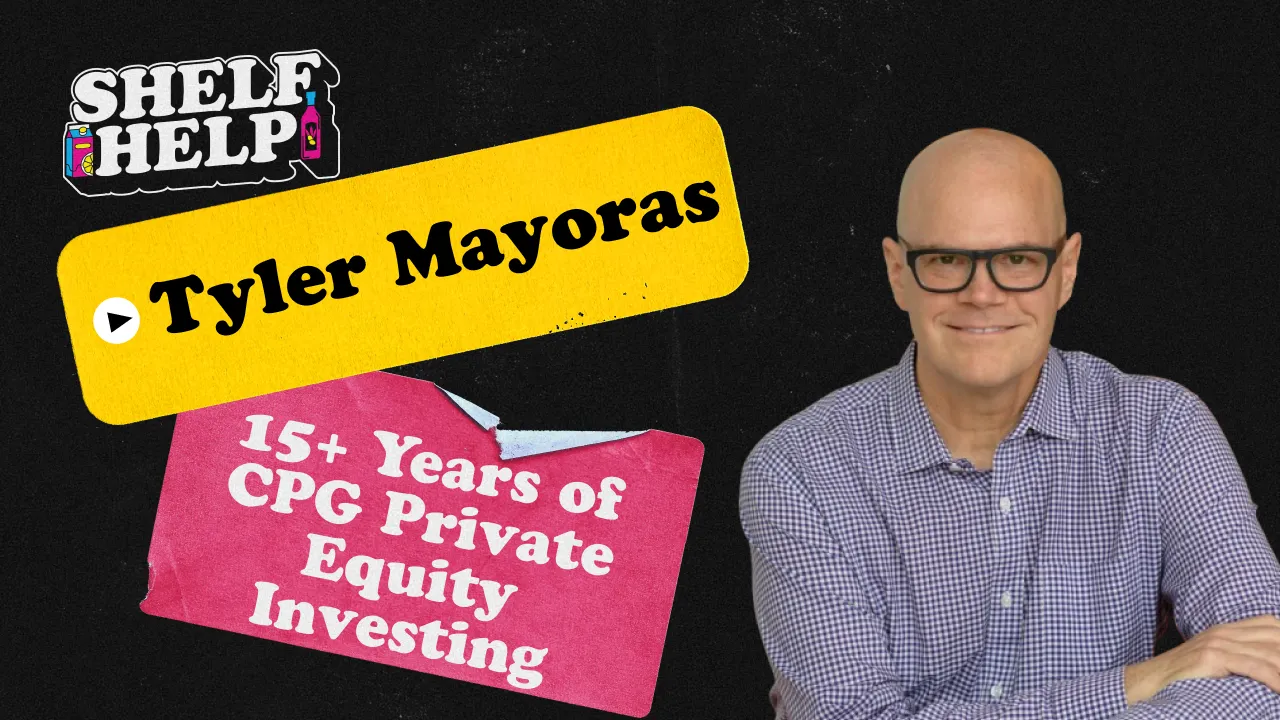



On this episode, we’re joined by Tyler Mayoras, Managing Director at Manna Tree Partners.
Tyler has spent over 15 years in private equity CPG, partnering with brands like Simple Mills, Health-Ade, New Primal, and Verde Farms. But he’s also been on the operator side, building Cool Beans from scratch, launching into retailers like Sprouts and Wegmans, and learning firsthand how to navigate the frozen aisle, regenerative sourcing, and repeat purchase velocity.
Tyler dives into the reality of regenerative, demo strategies, hero SKUs, what he focuses on when working with management teams, how he evaluates potential investment opps, and how the CPG PE landscape has changed over the past decade or so.
—---------------
Episode Highlights:
📦 Digital demos vs. in-store: what actually works
📊 Unit economics red flags (and how to fix them)
🔥 Why taste is the #1 investment filter
🧠 What makes a founder “coachable” and a brand a real target for Manna Tree
🛒 The problem with early national rollouts (velocity vs distribution)
💥 How one brutal Expo West conversation changed a founder’s trajectory
🐶 Two categories Tyler “missed”
—---------------
Table of Contents:
00:00 – Intro & Background
02:00 – Regenerative Ag: Promise vs. Reality
06:00 – Digital Demo Strategy & Social Nature
11:00 – Velocity vs. Distribution: What Founders Miss
16:00 – COGS, Margins & Pricing Power
18:00 – Hero SKUs and Hyper-Focus
27:00 – Investment Criteria & Team Dynamics
34:00 – Why PE Targets $25M–$75M Brands
39:00 – Trends Tyler Missed & What He’s Watching Now
41:00 – Where to Follow Tyler
—---------------
Links:
Manna Tree (join their newsletter!) – https://www.mannatreepartners.com
Follow Tyler on LinkedIn – linkedin.com/in/tylermayoras
Follow Adam on LinkedIn – https://www.linkedin.com/in/adam-martin-steinberg
For help with CPG production design - packaging and label design, product renders, POS assets, retail media assets, quick-turn sales and marketing assets and all the other work that bogs down creative teams - check out KitPrint.
Episode Transcript
Speaker: 00:00
All right. Welcome to Shelf Help. Today we're speaking with Tyler Mayores, who is joining us from Chicago. Tyler is a longtime investor and operator in the food and beverage space. Currently, he's a managing director of food and beverage at Manitree Partners, as well as a board member at various brands like HealthAid and New Primal. Before that, Tyler was the founder, for founder, and former CEO of Cool Beans, a plant-based brand that offered globally inspired plant-based wraps, among many other things. So excited to get into it. So, Tyler, just first off, maybe just give us kind of a quick lay of the land in terms of who Manatree is, what your focus is as a firm, and maybe it's taking a step back a little bit, kind of what led you to focus on the food and beverage space in general.
Speaker 1: 00:46
Yeah. Manatee is an investor that's particularly focused on companies that improve health through nutrition and wellness. So we are later stage investors. We invest when companies are between 25 and 75 million of revenue usually, and try to help them grow then to 150 to 200 million. We primarily focus on food and beverage, but we are also interested in clean beauty, fitness, vitamins, mineral supplements, VMS, etc. So really the wellness categories.
Speaker 2: 01:24
Yeah.
Speaker 1: 01:25
Yeah. And my my background, I've I've got probably 30 years of experience in private equity, and I did do a small stint running cool beans, but most of my time has been investing and started as a generalist in the last 15 years or so. I've been focused on food and beverage and more and more healthy and sustainable food and beverage.
Speaker: 01:48
Talking about sustainable, talking about cool beans, one question to add for you was but I know you've got a fairly strong interest and have invested in a number of companies that are focused on regenerative ag practices, simple mills, verde farms, cool beans as well, you know, new primal. There's a lot of excitement around the space, but you know, there's also a lot of challenges, I think, too at a high level. And I'll let you kind of take this however you want. Like, where do you see the regenerative space as it stands today?
Speaker 1: 02:19
Yeah. Well, I'm a huge fan of regenerative agriculture. And I think that many societies in the past have died, like because they've destroyed their soil. So it's critical that we not do that. And regenerative is a great path toward that. Having said that, unfortunately, there are a lot of things stacked against regenerative right now. And um, insurance is one, crop insurance lending is another. There's just not many lenders for regenerative agriculture companies. And so, and it's a lot harder. It's just a lot harder than getting on a combine and and mowing down corn, right? So I think that it will continue to grow. I think our goal, though, is probably to see it hopefully someday get to 5% of all agriculture in the U.S. You know, right now, 1% organic is just 1% of all of our uh, and and regenerative is actually harder than organic. It's uh that's still a very sizable goal, and hopefully we'll get there someday. But there we we really need to get uh a little bit more help from Washington and get some better regulations that allow for crop insurance and lending, et cetera.
Speaker: 03:35
Yeah. Yeah, well, that's a good dose of reality. Then there's the consumer side of things and where it comes into play. There's a concept that Fred Hart, designer in the space that you may have come across. I think he's done some work on some pretty prominent brands. He's talking about, uh, talks about this concept called Trojan horse positioning, where it's basically the theory is that brands should just really focus their messaging on ultimately just what matters to consumers most, even if it's not really what makes the brand unique. And it could have been a messaging that brands should think they should focus on, but do consumers necessarily care necessarily care about the most? Maybe not. Eddie's was an example that he was talking about where they they shifted away from talking about regenerative cheese to just focusing on an appetite-driven approach. They have protein in the product, it's better for you than buying cheese. It's so I'm curious, like, how does this resonate with you in terms of regenerative and how it actually should be positioned and where it comes into play in terms of messaging to consumers?
Speaker 1: 04:30
Well, what what I've seen work best is leading with health. So I believe that if brands simple mills did a really good job of this, they're nutrient-dense foods, and that's the first and foremost attribute. And it just so happens that they also were relying on regenerative agriculture and they started to push regenerative agriculture and with videos back to the farm, etc. But they always led with health. And that I think what matters to you as a consumer is what is gonna drive the day. And health is usually the number one attribute.
Speaker 2: 05:06
Yeah.
Speaker 1: 05:07
And so rather than leading with climate, climate can be an also, but it's not usually the primary driver to actually get velocities moving.
Speaker 2: 05:15
Yeah.
Speaker: 05:15
And it'd be nice to have it's not gonna be the make or break decisions.
Speaker 1: 05:19
Even a Verde Farms, while it's regenerative, and I think they're the only grass-fed beef company that is organic, regenerative, and fully grass-fed finished. And that's partly because it comes from Uruguay and they never went to conventional agriculture in Uruguay. But they lead with organic. That's what matters to consumers. That's the most important thing from a health perspective, no chemicals, et cetera.
Speaker: 05:43
Yeah. Shifting away from regenerative a bit, this is a bit more kind of in the weeds, but in talking about driving velocity, which I think we all know in CPG's kind of the holy grail. I think demos are often generally considered to be a pretty vital part of a brand's toolkit. And I'd bring this up because I know you mentioned to me that New Primal was using platforms like Social Nature, IELTS, and some other tools versus in-person demos, which I think is the thing that people typically think about as kind of the default. They're talking about demos. I'm kind of curious what was the thought process here, focusing on these kind of digital options, you know, better metrics, easier to track and attribute results. I imagine cheaper. But yeah, I'm curious what kind of thought process was there and what's been the results so far.
Speaker 1: 06:22
Well, well, demos, I would, I would say that if you look back in history, almost every brand that really became large did demos at one point. And demos are a really critical point when you're very early, especially when you have a localized approach. Maybe you're just growing in Southern California, demos and those kinds of events, event-driven marketing, can be very, very valuable. As you get bigger, though, it's just much harder. One, you've just got a lot more distribution points, but two, it's really, really expensive to try to demo across the country. And so some of these platforms that have grown up, like Social Nature, several of our brands, not just the new Primal, are using. And it's a great way to get product into people's mouths through a digital coupon. And then they usually tie it in with survey data or and or asking people to post. So you're getting user-generated content about the experience.
Speaker 2: 07:23
Yeah.
Speaker 1: 07:23
So that adds a little bit of a better element and it's a little more trackable. Because that is the one big negative with demos, is there's just really no way to track how how how much long-lasting value there was in that. Know that you have to get product in people's mouths. It's just what's the most efficient way to do it. So as you get bigger, uh it's it's much more efficient to use these other tools. Now, we still, when you introduce a new product, oftentimes that would come with demoing, even if you're a big company. But it's just much more limited.
Speaker: 07:56
Yeah. I yeah, to your point, I know tracking results in terms of in-person demos is is it's certainly not a clear science. It's hard to have that direct attribution. But from what you feel like you can track, what what have you found or seen in terms of comparing results and I guess ROI to a certain extent on the some of these digital, more digital options versus the traditional in-person format?
Speaker 1: 08:23
Yeah, well, it's uh it's almost impossible to actually track ROI on demoing. So it's the guess, guessing game. You can see how much you moved product while you were there, but that doesn't tell you anything about what happened next week, the week after, or other areas. So really, these are much more trackable because you actually get to see the purchases, the content that goes up on social media from from the people that tried the product and then their survey data, would they try it again?
unknown: 08:53
Yeah.
Speaker 1: 08:54
In some cases, I know with social nature, you they'll go back and check track six months later if they actually did purchase again with the survey. So some of that is very valuable.
Speaker: 09:03
Yeah. Yeah, that makes a lot of sense. Do you also come across this just came to me? I I wrote a small check into this company back in 2021, um, just because they were solving a problem that I was experiencing in my day-to-day, the past company I was helping run. And uh they have a platform, it's similar where long story short, we were doing a lot of tailor incentives. So, like incentivizing bud tenders at dispensaries, and they're super important. If someone walks into a dispensary and asks them, what should you buy and they recommend your brand? That's kind of how you win. But I'm I'm curious, this platform that I invested in, they also work outside of Cannabis 2 and a bunch of other traditional CPG categories, and they have a platform where they can basically incentivize the retail employees, but they actually can be tracked more efficiently, similar to how this demo digital platform seems to be much more trackable than in-person demos. I'm just curious, do you do you recommend or seeing in your brands your portfolio doing any type of incentives related to retail employees at all, too?
Speaker 1: 10:00
I haven't seen it with retail employees. We've definitely seen incentive programs, affiliate programs, basically, affiliate marketing for the DTC side of the business.
Speaker 2: 10:11
Yeah.
Speaker 1: 10:12
And that's fairly common. Somebody like New Primal, where a third of their revenue comes from e-commerce, they'll have affiliates for sure.
Speaker: 10:21
I think primal is just a side note. I don't you probably know better than I don't know what makes the texture uh of their meat sticks better, but it's basically the only brand I buy now. I don't know what it is, but it's something about other textures. It's just way better than everything else I can find on the market.
Speaker 1: 10:36
I've heard that from numerous people. I don't know exactly what it is that they do, but they obviously a proprietary formula. But I've heard people that prefer the texture over a chomps, etc.
Speaker: 10:48
Yeah.
Speaker 1: 10:48
Much more. Yeah. Yeah.
Speaker: 10:50
Anyway, staying on the on the topic of velocity, this is a question I like to talk with people a lot about, but it seems like you know, most CPG operators or investors that have had some success or experience along the lines, they often will say focus on velocity versus expanding distribution points as fast as possible. And I'm just curious from your perspective, just for that up-and-coming or first-time CPG operator who may not have that much clarity around that, can you maybe just help them understand why they should really just focus on velocity versus expanding those distribution points as fast as possible?
Speaker 1: 11:23
Yeah. Well, the first thing I would say, if you're a relatively new founder getting into the business, I would read the book Gramping Your Brand by James Richardson. He's great. It's a great book, and it will help you to really focus on what's important as you grow. The reason people say that, and I would say pardon, yeah, obviously, many people have recommended that book. Yeah, it's a it's a it's really very, very good. But the reason investors want you to do that, and the reason people suggest that is because it's very expensive to try to do marketing nationwide. And when you're a small brand, you have limited budget, and you've you've raised a certain amount of capital. If you don't want to raise tons of capital, then you want to focus in a region and really work on getting very high velocities in that region, which then other investors will look at and say, okay, I could apply that strategy to other parts of the country then. And so that's why people would then want to invest with you because you've proven it, even though you're not very big, but you've proven it in this market and you have increasing velocities in this market. So now we can go and take that across the country.
Speaker 2: 12:41
Yeah.
Speaker 1: 12:41
So that's why they say to do that. Because if you go out and you just launch with a large national retailer, you really need to then support every market with marketing.
unknown: 12:53
Yeah.
Speaker 1: 12:54
And that's promotion, but that's also some kind of digital and you know, even outdoor, just uh however you can build brand awareness, yeah, and you're gonna have to do that across the nation rather than just in a region. So it's a very expensive.
Speaker: 13:10
Yeah, that makes a lot of sense. If you have a repeatable, provable process that you can just then scale, certainly there's standard investors would be more interested in that. Um what what would you say are like some of the key things that operators and and brand owners should actually focus on if they want to maximize velocity in those regions that they're really focused on.
Speaker 1: 13:30
So for focusing on just specifically on velocity?
Speaker: 13:34
Yeah, exactly.
Speaker 1: 13:36
Yeah, so I would say that the number one thing is promotions. That's the easiest way to get people to try your product. And so you have to have a promotion strategy. I like a lot of demos, certainly in a region is makes a lot of sense.
unknown: 13:50
Yeah.
Speaker 1: 13:51
But the key, and one of the keys that comes out of that book, Ramping Your Brand, that I think is so critical, is when you think of velocity, oftentimes you say, okay, well, we we sell five units a week. And most people would look at that and say, okay, that means five people bought the product. That's not what it means. It means probably two people bought those five units. Right. Maybe one person. And so what you have is power users, and you need to get more power users. And the way to get more power users is to try getting product into people's mouths. Some of those people are going to really love it and they're going to become power users. So you've got to continually find ways to get product into mouths. That can be bogos, that can be discounts, that can be demos, that can be digital demos, these different programs. But basically, you have to get product into people's mouths so that they can really see this is what I like, and then hopefully they'll continue to repeat. So that's how you that's the process. And what you see is that then a stair step approach or a stair step chart. You know, there'll be three or four months that are at one level, then you'll do promotions, it'll pop up a little bit. Hopefully, you stay three or four months at that level, then you do promotions, it pops up again. And so with really good brands like a good culture or a new primal, you'll see that stair step in each retailer. And that means that things are going well. You're increasing velocities with that retailer.
Speaker: 15:12
Yeah, so velocities, and then also you have those repeat purchases. Which one of those would you say is is more of would be more of a red flag, like assuming the metrics aren't where you would like them to be in terms of repeat purchases aren't aren't there or velocities aren't there? And maybe they're too closely related to kind of just delineate between the two, but I'm curious, does one become more of a red flag to you if it's not there versus the other?
Speaker 1: 15:35
Yeah, they're definitely related. I think what we what becomes a red flag is if you look at somebody's chart and every time they promote, their volume and velocities just drop back down to the red level that it was before or even lower. Yeah, that says that it's not moving the needle. You're not getting more power users. Something might be wrong with the product, you might need to tweak taste or something else. One of the other attributes isn't resonating because people aren't repurchasing. Yeah. So that's a red flag for sure.
Speaker: 16:08
Yeah. Yeah, that's that's super clear. Shifting direction a little bit, talking about cogs and margins. When it comes to actually projecting cogs and margins, I know there's a lot of ways that you can end up getting yourself in a difficult place where you weren't projecting accurately. What would you say are that you found are some of the most common ways that operators get this process wrong? And up-and-coming ones that are listening, how can they plan ahead so they don't get it wrong?
Speaker 1: 16:33
Yeah, well, cogs and and gross margin are critically important. And the reason is if your margins are 20 to 30 percent, you're gonna have to raise a lot more money than if your margins are 40 to 50 percent. Uh you're just gonna have to keep going back to the well because you're not making enough money. I would also argue that if your margins are less than 40 percent, now there's certain everything's category dependent, but if your margins are less than that, it really calls into question whether you have a product that people are willing to pay up for and that basically validates your differentiation strategy. And so that's something to really be cognizant of. I know founders oftentimes want to stay really close to the competition on pricing, and that competition might be 20 times bigger than them. But the reality is if you're doing something very different, very clean or higher protein, higher fiber, you need to try to charge for that.
Speaker 2: 17:42
Yeah.
Speaker 1: 17:44
To create margins that make the business sustainable. And that's what we call unit economics. If your unit economics just aren't there, I really question whether you actually have a differentiator.
Speaker: 17:56
When you're working with management teams at the bit of a the more mature state, when you're working with those brands, what are one or two or a few key things that you really like to focus on when you're working with them on the phone?
Speaker 1: 18:06
It's a very good question. The number one I would say is me personally. I'm pretty tyrannical, I'm pretty um hyper focus on focus. And and the reason being I've just seen brands just when they're really focused on one hero product, they just can really kill it.
unknown: 18:27
Yeah.
Speaker 1: 18:27
And so good culture is a great example of that. When we first invested in good culture, you know, they were probably about 40 million in revenue. We invested with SEMCap, another great CPG investor, and they were starting to branch out into sour cream, probiotic milk that they were doing as a joint venture. And our team, I wasn't there at the time, but our team did a very good job of basically getting them hyper-focused on cottage cheese. Because they couldn't keep cottage cheese on the shelf. It was clearly resonating with people. They were transforming the industry with a probiotic cottage cheese, which was the first in a while. All product, all cottage cheese has probiotic benefit, but they usually go through a kill step. And unlike yogurt, they didn't have the probiotic benefit any far any longer. And so by turning the industry on its head, they were really changing the health benefits of cottage cheese. And so our team and SEMCAP really got hyper focused on that focus. And so they they've now grown, I think, fivefold since we invested, and it's all 97% of the revenue is cottage cheese. And that is because they have just a great hero product. So if you can figure out your hero product and then really focus on it, that's the recipe for success in my mind. And sometimes that means pivoting. You know, in the case of Simple Mills, when I first invested with them, they were a baking comp a baking mix company, but they were transitioning to crackers. Crackers was going to be their hero product because baking mix is really is not a hugely people don't really want to work that hard. You know, there's some people love to bake, but but not everybody wants to. So that's not a huge high velocity part of the grocery store.
unknown: 20:19
Yeah.
Speaker 1: 20:20
But crackers is a high velocity skew. And so they then focused very deeply on crackers. Even today, you know, when they sold, they were 240 million in revenue. And even then, crackers was their hero skew. And they had multiple types of crackers. They had branched into other things like cookies, et cetera. But crackers was still the predominant revenue source.
Speaker 2: 20:45
Yeah.
Speaker 1: 20:46
Another great example is the new primal, which when we and I first joined the board, we were trying to figure out they had a meat snacks business and they had a sauce business. The sauce business was small, and we were thinking, do we want to make acquisitions there and try to grow that? And because we're gonna have to sell them separately. The same person's not gonna buy meat snacks and sauces. But I remember my first board meeting, we were sitting in the board meeting where and meat snacks was growing faster. Protein was starting to come to its own. This was a couple years ago.
Speaker 2: 21:18
Yeah.
Speaker 1: 21:19
And during that time, I think it was the CFO or or maybe it was Jason, said, you know, yeah, and and started talking about snack mates, and snack mates was this tiny little product, but it doubled each of the last two years. Yeah. I said, say more about that. And so it had gone from two to four to eight. And we talked, delved, dived into the whole thesis behind Snack Mates, and really what they had done was created products that were for kids' palettes. It was maple and chicken and maple and chicken and apple, and things that didn't have the spiciness of most meat snacks. And they had kids' packaging, and it was very unique. Nobody else was doing it. And we decided as a board, that's where we should focus that this should be this is our hero product. And if you then fast forward, now it's more than 50% of the revenue of the company. I think over 25 million this year will be just snackmates alone. Um and so that ultimately is their hero product. They've leaned into it deeply. The whole team got focused on it. We've sauces are just on a shelf, not doing anything to try to grow revenue there. But really, we knew that snackmates was the thing that was really going to be different and take off. So that's really what you have to do is you have to find that hero product and then just get tyrannical about it and focus on it.
Speaker: 22:44
I imagine from your guys' per perspective, the value of getting real feedback.
Speaker 1: 22:50
Yeah, that's a very that's a very good point. As a founder, I really saw this first firsthand. The feedback that you get from friends and family is almost worthless. I mean, it just really is.
Speaker 2: 23:00
Yeah.
Speaker 1: 23:01
Nobody wants to hurt your feelings. Nobody wants to give you any real feedback. And even people in the industry, for the most part, don't give, I give brutal honest feedback, but most people will not. And that doesn't help you. So you need to kind of get consumer-based testing. You know, you need to get the product in front of people, the concept, get people tasting it. People that they don't care if they hurt your feeling because they don't know you. So that's who you want to hear from.
Speaker 2: 23:31
Yeah.
Speaker 1: 23:31
I personally just always want to give brutal feedback because the hardest thing, the thing you'll never get back in life is time. And if somebody wastes three to five years of their life on something that probably isn't going to go anywhere, I want them to know what's ahead. And a great example of that. It was a sad story that became really happy. But it was I was at Expo East maybe three or four years ago. And the a good friend of mine, Eric Schnell from Beyond Brands, introduced me to this young founder, and they had a new product. It was an and this was before there were a lot of these drinks with adaptogens in them. And they wanted to create this adaptogen-based drink that was a refresher and hydration, but also had these other added benefits for calm, et cetera. And I said, Yeah, but that sounds like a great idea. And then they told me the name, and we tried the beverage, and the beverage just tasted terrible. And the name was weird. I wish I could remember what it was, but they had merged two words together that don't normally go together, and they were doing it because it was something about you know changing your mood and whatnot. I was like, you just spent five minutes explaining what the name is to me. So then nobody reading this on the shelf is going to understand that. It's just never going to happen. And so I just gave him brutal feedback. I said, look, the product doesn't taste very good, the idea's great, and the name's terrible. And I, you know, I felt bad this kid was like 25 and he was a college athlete. He and his brother were doing this, and I could see him like almost welling up right there in front of me. And I'm like, you know, this is terrible. It's not like I want to be mean to me, but that felt terrible.
unknown: 25:18
Yeah.
Speaker 1: 25:18
But I knew that if he went down this road, he had maybe a 5% chance of winning with the way it was formulated, maybe less.
Speaker 2: 25:26
Yeah.
Speaker 1: 25:27
And so the funny thing about that story is a year later I'm at Expo West, and some guy comes running up to me, didn't recognize his face at first. And he goes, Dude, dude, you won't believe this. We changed the name, we changed the product, we listened to your advice. And I was like, wow, what are you talking about? And so he had showed me they basically had changed the name, and now it was called Leisure. And they had the product tasted great. It was completely reformulated, and now they're launched and they're um growing in the Los Angeles market. They're doing really well. I think they're I think they're in the single million dollar range, but growing, and they've got investors. And uh it just it was really rewarding to see that somebody took the advice and said, okay, we got to go back to the drawing board because otherwise we're just gonna waste a lot of time. And so, you know, knock on wood, they'll they'll get someplace.
Speaker: 26:24
That's great. That's a great story. I I actually I met the Leisure Project guys at Expo S the March. First time I tried the product. It was really really good.
Speaker 1: 26:32
Yeah, it is really good. Yeah, exactly. And at the time it was pretty unique. Now there's quite a few people doing it now, but they still have a unique angle on it, and um, hopefully they'll continue to grow.
Speaker: 26:45
Well, that that feedback is is really helpful. I I write a few small changel texts here here and there. And I think like a few things that I think about when I'm looking at it, VG is like obviously the founder and the team, the product obviously has to taste amazing and you're just the overall product experience good. Obviously, the Unix and economics have to be there, velocity is an indicator of your product market fit. Um, and then the other one, does it have a clear place on the shelf? Because it seems like if it's does it have a clear place of where it's gonna fit in the store, I guess, whether what aisle or what section? It seems like what I've feedback I've heard is if brand's approaching a retailer or a buyer and it's not clear where it's gonna fit in the store, it's much harder for the buyer to kind of envision where this is gonna fit and how it's gonna work. I'm curious, like what are the top variables that that you take into account that you feel are the most important things as you guys are looking at deals?
Speaker 1: 27:34
Yeah, well, clearly founder team is is a very important one. But when you think about founder team, because we we tip typically take an active role in helping to shape that longer term, like by adding key members and working with team coaching and things like that. But the real key for me with a founder is somebody that's receptive to change. Because as you grow, if you think about a company with $10 million, you know, that that company's CEO is going to be making all the decisions and involved in every decision. But when that company gets to $200 million, they can't be involved in the decision. So you have to be willing to push down decision making. And that isn't always evident and requires a lot of one-on-one conversations and whatnot with CEOs because it's critically important whether when you think of the really good CEOs that have grown and become the same CEO founder at 200 million, Jesse Merrill at Good Culture and Caitlin Smith, they all were willing to make that change and adapt. And so that's critically important. Um and the most important part of the team. Unit economics is always very high on our list. When you think of unit economics, it's really about because it might be that they're just afraid to charge enough. Are they charging enough for the product? If their margins are only 30%, is it 30% because they're just afraid to charge? Or is it 30% because it's just structurally they can't do any better than that? And that's we try to dive into that because something like a good culture where you can't keep the product on shelf, we've increased price multiple times because you haven't really found the spot where there's not saturation really. So it's important to be able to figure that out and you get a feel for that. The place on the shelf is important, although I've seen a lot of really good companies create categories. You know, once upon a farm is a great example of that.
Speaker: 29:46
And yeah, good point.
Speaker 1: 29:47
Now you've got a legendary founder there and a celebrity involved, so that makes it a little bit easier. But people are creating categories all the time. Mush is another example. They're being sold in the yogurt space, but they're really an overnight oats company that's ready to eat. So that's it's it's interesting. Those things can happen, they are harder, but they also can be much more rewarding.
Speaker: 30:13
True, yeah, for sure. If you make it, if you make it work, it can be a much bigger upside, right?
Speaker 1: 30:18
Yeah. I think the the biggest thing about differentiation. And we have this conversation a lot with the team, because you know, people will say, what's the moat? And I have I blanch at that a bit. And the reason is because I don't believe any with today's food scientists, we have just amazing food scientists across this country, and I believe that they can replicate any product on the shelf. Oreos, Doritos, whatever you want to say, they can replicate the exact case. But they can't supplant that brand. The mode is the brand. And that's really vitally important in what we look at is what, and and that when you're small, what that brand is, is how does it resonate with the consumer? And usually it's associated with a founder story. So there was almost always there was something that happened to the founder or somebody in their family, and they changed how they were eating as a result, and that led to this product. And that then really resonates with consumers, and consumers hold that and say, yes, I can see me in that. And that is vitally important to building a moat. So when I think about moat, it's usually around the brand, um, as opposed to some kind of unique scientific formulation patented. Yeah, I just don't see that as much. And like I said, there's the food scientists can replicate anything these days. So it's really about building that emotion through the brand that you create the most.
Speaker: 32:00
Talking about the unit economics that you mentioned for a second, at the stage that you guys come in, you guys only make investment if the unit economics are already there, or were you guys willing to take a bet if you see 35% gross margins, but you think you look at the business and you say, clearly these guys could be charging more if they just haven't yet and they've been apprehensive to do so, or are you only willing to come in when you've and the unit economics are already there?
Speaker 1: 32:23
Uh it's certainly easier if the unit economics are already there, but we will do either. We'll do either. We just want to we want to be able to see. Now, one of the things for us is we're investing later and we usually want to see that they're actually profitable. Yeah. So at the EVITAM art line. Yeah. And if somebody's got 25% gross margins, they're probably not profitable at the EVITA line. It's just really hard to do. So it's going to be less likely that we're going to be able to invest in something like that. Not every company is 100% profitable when we invest, but we've got to see a clear path within the next six months or seven months to get there. We're not venture investors.
Speaker: 33:06
Yeah. Yeah.
Speaker 1: 33:08
But if we think that somebody we we definitely have inklings of businesses where we think that there's more margin to be had, that they're not charging enough, if you will. Um and yeah, we'd be very interested in those. It might, it might be that they're 30% or 35% and they could be higher. Sure.
Speaker: 33:30
But yeah. I imagine maybe when you're coming to those, you may be able to get a you know, a more competitive valuation from your guys' firm perspective, I imagine. Theoretically, maybe it could be.
Speaker 1: 33:40
Yeah, it it depends. Sure. It's um I mean somebody somebody that comes to us with 50% gross margins, it's it's very demonstrated that they know that they can charge and they may be able to charge more.
unknown: 33:53
Right.
Speaker 1: 33:54
You know, it depends on what how fast the product's moving off the shelves or online, etc. But um so that definitely is a critical element that we look at as we're coming into companies for sure.
Speaker: 34:08
That makes a lot of sense. I know you focus on companies that are in that $25 to $75 million range. Why is why is that the right stage for PE to come in? And and maybe more specifically, why is that feel like that's the stage that Manatree wants to focus on and what your team wants to focus on?
Speaker 1: 34:25
Yeah, it's it's the right stage for us. That's where we play. It's it's kind of an uh an interesting little cycle that's developed because CPG companies have moved up market and they really won't buy companies now. They'll buy distress companies, but they won't buy strong companies until they get kind of close to that $200 million range.
Speaker 2: 34:50
Yeah.
Speaker 1: 34:50
And the reason because is because they get orphaned if they buy too small too soon within that big CPG network. So that's created opportunity. So you've got early stage investors that kind of help the company bootstrap up to that $40, $50 million range. Then you have people like us that come in. We typically invest $20 to $50 million into companies, and usually only maybe 10 million of that, 15 million of it, goes into the company. The rest goes is secondary to early investors and founders that maybe want to take some chips off the table. Because to be honest, to get to 50 million, they've probably been in this for eight years. This is these are not overnight successes. There's no such thing. And so it's been a long time and they need to get some money back for their investment, et cetera. They may not sell at all, but they sell a portion.
unknown: 35:43
Yeah.
Speaker 1: 35:43
Then what's interesting is what's also developed now is so let's say we take that company up to 150, 200 million. There's now a whole group of other investors that want to take it to invest again and take it to 300 or 400 million before selling. The TSGs of the world, Investar and Catterton. And so that's an interesting newer development where you see large CPG companies, emerging companies, sell to other private equity groups. And maybe they buy 60% or 70% of it. We get a bunch of our money back and some return, but then we also ride into the next round before selling to the full, full CPG sale.
Speaker: 36:30
Yeah. I think I heard you say that's a bit of a newer concept where some of these, what if you call them growth equity investors are coming into that at that later stage and purchasing the company from you? If that's a newer thing, why was that not as much of a factor or part of the market as whenever it used to be, whenever how long ago it wasn't a part of the market?
Speaker 1: 36:46
Yeah, it's a good question. The market has evolved primarily because of CPG demand, large CPG demand. So when I first started in the industry, basically there was a formula. When you got to 50 million, big CPG would buy you for two times revenue. And that was the that was the formula. It didn't matter if you made money, none of that. It was just two times revenue. That started to transform. There was a period of time where it went up to three, four times revenue. Now it's come back down and it's really about profitability. They want to buy companies that are already profitable because they know that those companies can charge for their product. They have strong demand, et cetera. But they've moved up their hurdle to that $200 million range. So the TSGs and the Vest Stars of the world, they might have been investors like us 10 years ago investing in our size range. But now they've moved up market and now they want to invest 100, 200 million into companies. And at the same time, CPGs won't buy those companies. So it becomes this, it just an opportunity has come about that didn't used to exist. So when Simple Mills first did their transaction, they went to sell, I think it was three years ago, um, four years ago, and they couldn't get large CPG to buy them at the price they wanted. But Vestar, and I think there were a couple other private equity groups, were offering three times revenue. And they came in and they bought at the time 40% of the company. And then, and I think at the time the company was like 70 million in revenue. And then the company grew while Vestar was a 40% owner to 240 million, and then we sold for 750 million. Right. Um it's become a very good formula for people like us to sell to um because uh CPGs are taking a longer term approach to when they'll come in.
Speaker: 39:00
And what when you sell to those to those other firms, are you typically selling your entire stake or are you still got equal to the state?
Speaker 1: 39:06
No, yeah, that's a misnomer. It's not we're not selling, we're basically it's like a recap transaction where we where they'll buy into somewhere between 40 and 60 percent of the company, probably. And then we continue to be owners, all the original investors continue to be owners. It's usually on a pro rata basis, everybody sells, so except for management. Management sometimes doesn't want any soul to sell on a piece and they want to keep just roll so they own more when it ultimately sells. Yeah.
unknown: 39:37
Yeah.
Speaker: 39:37
Well, that makes sense. Yeah, yeah. Last question for you. What's a trend or opportunity that's come across your desk that looking back, you wish you would have jumped on or taken advantage of that let you pass by, or if there aren't any that come to mind, any just trends in general that you're excited about right now?
Speaker 1: 39:53
Yeah, well, there's a lot. I'd love to say I was a perfect investor, but I'm not, you know, I've made mistakes. So had a lot of successes and had a lot of failures as well. And then the ones that you miss are also failures, but certainly the prebiotic soda would be one I would I would say, you know, and and we did look at as a firm before I was here, we we looked at Olipop a couple times. But at the times, the company was losing a lot of money early in its life. It's obviously making a lot now, but it was losing a lot then. And it also always had carried a high valuation. And we're not probably we're not real speculative investors for high valuation businesses. We'll we'll pay up for certain things to a certain degree, but we're not the kind of guys that are going to pay five times revenue and take real kind of ventury risk like that. I would say another one is the whole human-grade dog food. Okay. You know, with Farmer's Dog has been it's an amazing story. It's a yeah, and I think that that's a billion-dollar company now, and all almost all DTC and just really impressive what they've done.
Speaker 2: 41:02
Yeah.
Speaker 1: 41:02
So I I think those would be areas, and we and until this third fund that we're in now, we couldn't invest in. We were really human health focused, but now we're branching out to include we look at pets, both the health of the pet as well as the health of the human, because they have a healthy pet, is it it improves your health in that way. And so that's how we're looking at it. But it's definitely an area of interest.
Speaker: 41:26
That totally makes sense. Yeah, for sure. Well, yeah, Tyler, it's been great. Really appreciate the time. It's been awesome. I think a lot of really valuable insights. I think uh listeners are gonna get a lot out of this. Where's the best place to follow along with follow along with you?
Speaker 1: 41:38
Yeah, so I'm on I'm on LinkedIn, I'm no longer on Twitter. I I kind I kind of got rid of that, but um I'm yeah, I you can catch me. I do do occasionally do something on TikTok, but we have a newsletter on our website at Manatree that you you should definitely subscribe to because there's a lot of great insights into that. And we um we've got a marketing team that creates white papers on some of the trends we see in the industry. So that's definitely worth subscribing to. Awesome. Yeah. Thanks, Alan. Appreciate the time. It's been great. Thanks very much, Adam. Appreciate it. For sure. Okay, bye bye.
.svg)


